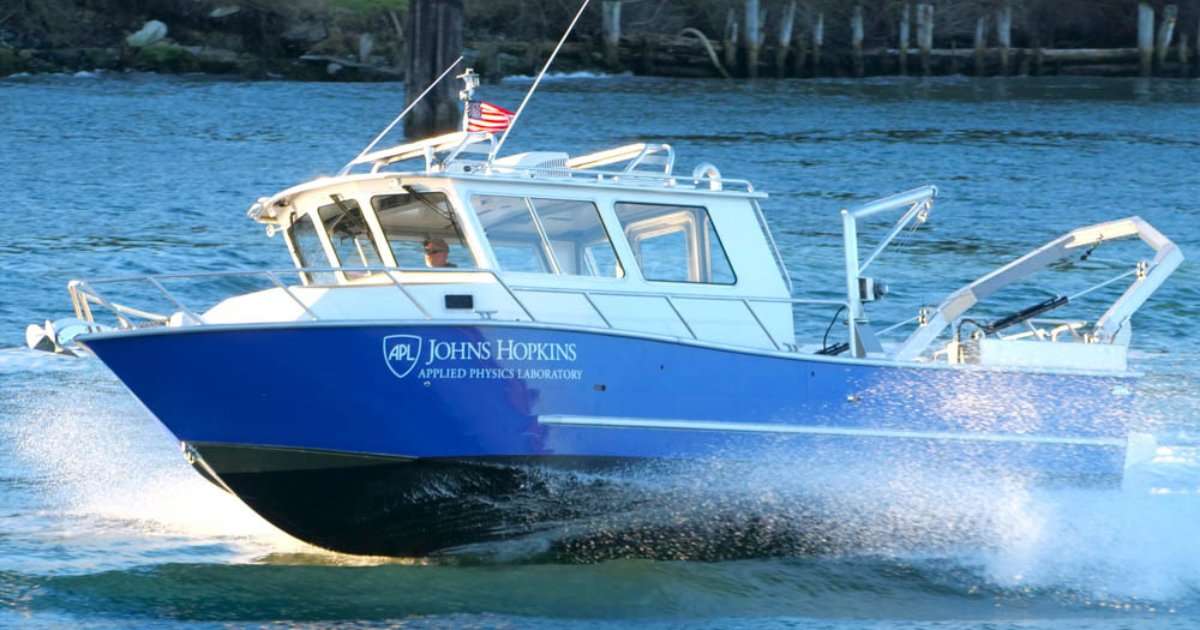
The new utility vessel, christened Sea++ in a nod to the foundational programming language C++, will serve as a configurable research platform for testing maritime technologies across a broad range of applications. In addition to enabling rapid experimentation, the vessel reduces many of the logistical constraints associated with chartering commercial vessels, allowing research teams to move from concept to on-water testing in weeks rather than months.
“Maintaining our maritime advantage depends on our ability to learn and adapt faster than emerging threats,” said Vernon Parks, who leads APL’s Sea Control Mission Area. “The Sea++ gives us a flexible environment to rapidly evaluate new ideas, reduce technical risk, and deliver more mature capabilities to our sponsors.”
Designed with adaptability in mind, the vessel is equipped with a modular electronics rack, internet connectivity, integrated lifting systems including an A-frame and movable davit (boat crane) for deploying and recovering equipment, and dedicated mounting points that allow it to be quickly configured for a wide range of experiments, testing everything from autonomous surface vessels and advanced sensors to communications systems, robotics, and other emerging maritime capabilities.
In one demonstration, the vessel showcased how unmanned systems, including unmanned aerial and surface vessels (UAVs and USVs, respectively), could be used to enable agile logistics for resupplying platforms deployed far from sea. In the demonstration, UAVs landed on the Sea++ as it was transiting in the water, allowing engineers to fine-tune the perception, guidance, and control required for UAVs to land on a moving target.
In another experiment, APL researchers ventured aboard the Sea++ to test the Vitals for Open-water Location and Tracking (VOLT) system. VOLT is a compact, water-resistant device designed for search-and-rescue missions. Worn beneath the collar, it transmits the sailor’s position over satellite links and provides confirmation that help is on the way.
“Sea++ provides far more than just a platform to conduct our testing,” said Jason Tiffany, an APL engineer and principal investigator of VOLT. “Its onboard communications and connectivity allowed us to maintain real-time coordination with our Coast Guard partners and keep our sponsor engaged throughout the test. APL’s captains went above and beyond to support the effort, from capturing aerial imagery that gave us valuable additional perspective to safely recovering equipment using the vessel’s integrated lifting systems. Those capabilities helped make the test both more efficient and successful.”
Beyond accelerating access to on-water testing, Sea++ has expanded where and when researchers can operate. During one test, the team traveled more than 100 nautical miles to Cape Charles, Virginia, to collect data, an expedition that would not have been practical using smaller platforms. The vessel’s enclosed cabin also enables testing in colder weather and more challenging sea conditions, providing a protected workspace for researchers while exposing technologies to operationally relevant maritime environments.
“Instead of engineers staying on shore while we’re out on the water relaying information back and forth, they can now be onboard to see the testing firsthand,” said Nick Duff, a US Coast Guard-licensed captain and maritime electrician at APL. “That immediate visibility gives them a much better understanding of what’s happening and helps streamline both software and hardware development.”
For projects involving sensitive technologies, operating from a Laboratory-owned and -managed platform also provides greater flexibility to support secure testing activities without many of the constraints associated with commercial vessels.
“Whether a team is developing autonomous systems, testing new sensors, or evaluating emerging technologies, this vessel makes it easier to get on the water, experiment, and iterate,” said Adam Watkins, who oversees APL’s Maritime Robotics Group and Sea++ operations. “By removing many of the logistical barriers to testing, we’re helping engineers move at the pace today’s missions demand.”