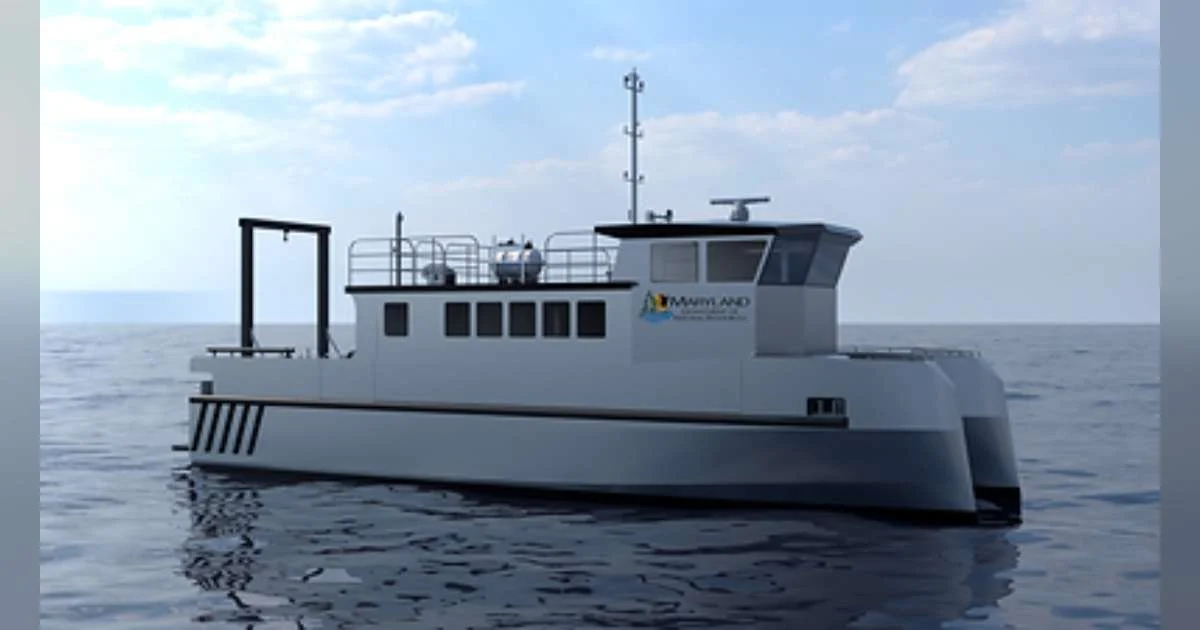
Designed in collaboration with Chartwell Marine, a UK-based naval architecture firm specializing in high-performance aluminum workboats, the vessel will combine near-coastal capability, dynamic maneuverability, and mission-specific research functionality in a rugged aluminum platform engineered to demanding government specifications.
This latest LM Workboats project supports the Maryland Department of Natural Resources initiative to develop a next-generation Chesapeake Bay research vessel capable of providing critical monitoring information to help protect and restore Maryland’s water quality and habitat conditions. The vessel is intended to serve as a state-of-the-art, multi-mission platform capable of safely conducting year-round operations in inland Chesapeake Bay waters and near coastal Atlantic waters under a wide range of operating conditions.
Measuring 59.06 feet LOA with a 19-foot beam, the vessel is powered by twin MAN diesel engines and designed to achieve a speed of 20 knots at 90 percent rated engine power. A dynamic station-keeping system will allow the crew to maintain precise position during sampling and data collection, even in challenging tidal and current conditions.
A large aft working deck with integrated A-frame equipment-handling capability will support deployment and retrieval of sampling gear, buoys, and other mission-critical equipment.
“This project reflects the growing demand for highly specialized aluminum workboats,” said Jonathan Egan, Division Manager of LM Workboats. “Maryland DNR came to us with a genuinely complex brief—a vessel that had to perform as a research platform, meet rigorous Coast Guard and UNOLS standards, and operate reliably year-round on the Bay and near-coastal waters. That’s exactly the kind of project our team is built for.”
The vessel will be built to US Coast Guard Subchapter T, ABYC, AWS, and UNOLS standards, receiving a Certificate of Inspection for up to 20 passengers on inland and near-coastal waters. “Subchapter T means every aspect of the build, from structural engineering and welding to fire suppression and stability testing, is independently reviewed and verified,” said Egan. “There are no shortcuts, and that’s exactly what a government research vessel demands.”
LM Workboats will construct the vessel in its 15,000-square-foot dedicated metal fabrication facility in Rockland, Maine, before final outfitting and systems integration at the company’s Thomaston waterfront facility.
The Maryland DNR vessel adds to LM Workboats’ established portfolio of advanced aluminum workboats delivered to government, municipal, and institutional clients across the United States.
Lyman-Morse is one of the few boatbuilders in the United States with ISO 9001-certified quality-management systems supporting marine manufacturing operations. The company also maintains AWS-certified welding procedures, certified welding inspectors, ABYC-certified technicians, and rigorous material traceability and inspection protocols throughout construction.