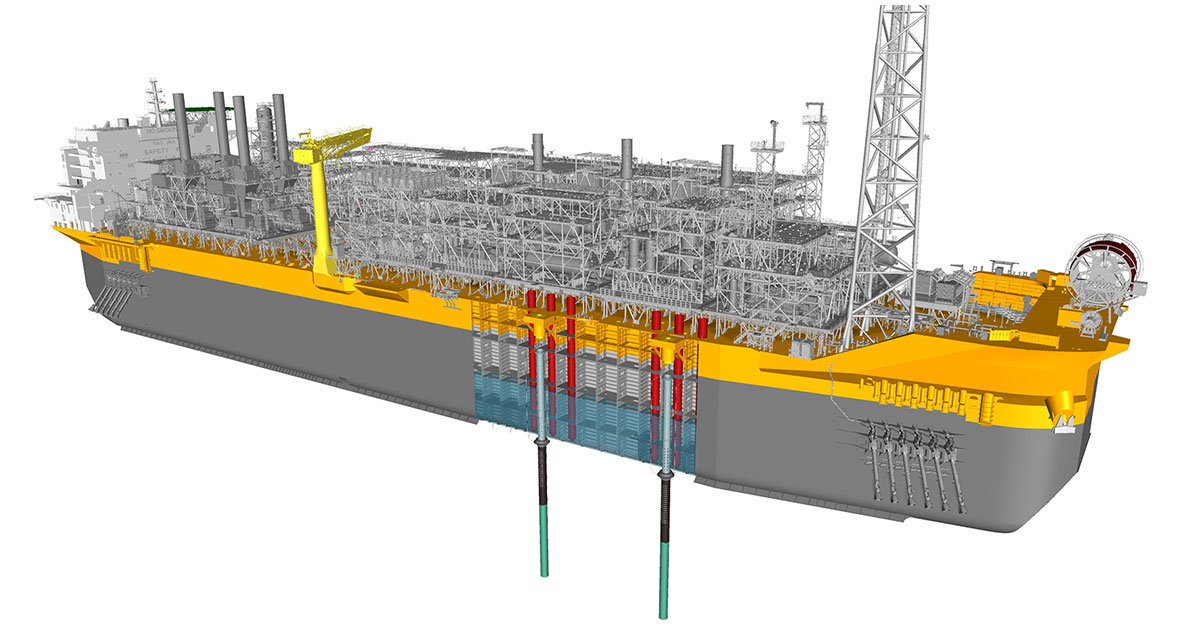
Developed in collaboration with Shell, the SWIR technology features an innovative technique to pump colder seawater from approximately 700 meters below the ocean’s surface up to an FPSO’s topsides to be used for cooling purposes.
Depending on process conditions and site characteristics, SWIR can use cold seawater for onboard process cooling and power generation, improving energy efficiency and reducing fuel gas consumption and greenhouse gas emissions in offshore oil and gas production.
To evaluate the prototype design, ABS applied its New Technology Qualification (NTQ) program, a structured engineering approach to systematically and consistently assess innovative solutions. The Statement of Maturity means that after tests and validation, the technology is qualified to be incorporated into a production unit.
Laurent Le Touzé, SBM Offshore’s Technology & Product Development Director, said: “SWIR’s development reflects SBM Offshore’s innovation leadership and its commitment to supporting the emission reduction journey. SWIR is an important step in our low-carbon roadmap: the project began as an in-house concept in 2014 and advanced through a multi-year, multi-party effort, including a development partnership with Shell and research input from academic institutes.”
This milestone follows the successful completion of a six-month prototype qualification campaign in 2025, witnessed by ABS, Shell, and Petrobras. The NTQ confirms that the SWIR design complies with ABS safety and regulatory standards—a key step toward deployment.
“Completing the prototype validation stage is a testament to the strength of our collaborative relationship with SBM Offshore and our collective dedication to engineering excellence and safety. ABS is proud to support forward-thinking solutions that will refine and elevate the next generation of offshore energy infrastructure,” said Leile Froufe, ABS Vice President, Engineering.
“We are optimistic about the promising results achieved by the seawater intake system project. The technology will enable significant optimization and performance improvements in FPSO process and utilities plants, while also contributing to the decarbonization of offshore oil and gas production,” said Eli Gomes, Technology Project Manager at Shell Brasil.
The project was supported by Shell Brasil through the Research, Development and Innovation (RDI) investment clause of Brazil’s National Agency of Petroleum, Natural Gas and Biofuels (ANP).