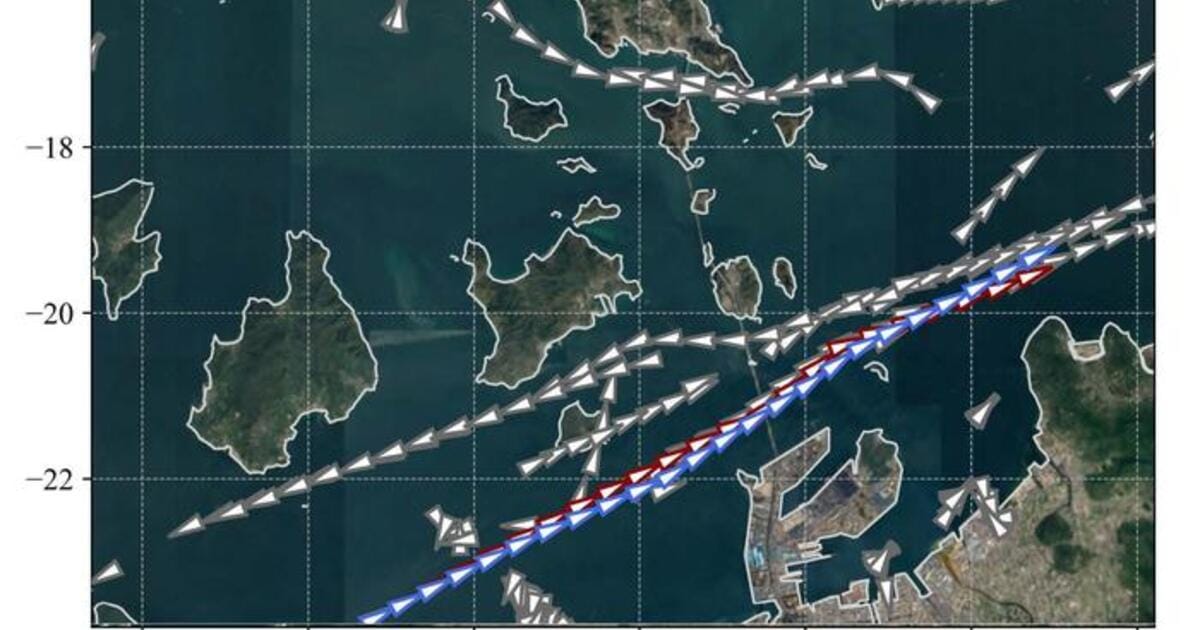
Instead of training their model with objectives and rules, the researchers used the maneuvers performed by the vessel Fukae-Maru, a training vessel from Kobe University. Rather than trying to predict the best action like traditional AIs, the researchers turned to “diffusion AI,” which instead makes decisions based on a range of actions that experienced humans might take and creates a whole trajectory. As the ship operates in the congested Seto Inland Sea, the operators have to make decisions that involve ambiguity and human judgment, sometimes making decisions that are difficult to describe mathematically.
The researchers evaluated their AI against two leading navigation AIs built using conventional machine-learning methods based on imitation-learning. They found that their AI effectively handled situations that confused the other models. It was able to simultaneously handle arbitrary numbers of ships, coastlines, narrow waterways, and speed control in a realistic simulation. When they ran ship encounter tests, it consistently complied with international collision-avoidance regulations, maintaining a safe distance from other ships.
As the model was trained, it began to show unexpected behavior such as performing local navigation customs that were never programmed. A local convention when passing through the Akashi Kaikyo Traffic Route is to keep right within designated traffic lanes. Although this was never explicitly programmed into the AI, it consistently maneuvered the vessel into the correct traffic lane.
“The most distinctive feature of this study is that we did not explicitly balance multiple objectives such as collision avoidance, geographical constraints, navigation efficiency, and compliance with maritime traffic rules; however, the AI achieved them,” Dr. Higaki said. “Our approach enables the AI to autonomously learn sophisticated ship-handling skills directly from real-world operational data rather than having researchers manually define what constitutes correct behavior.”
As more real-world vessel operation data become available and their use continues to expand, autonomous ship navigation systems will become more common, similar to the recent increase in AI-driven cars. The researchers hope that their study will improve navigational safety and help to address the labor shortages that are increasing in the maritime industry, especially in Japan.
The study was published in Ocean Engineering.