The ocean underpins the safety, wellbeing, and livelihoods of communities worldwide. Understanding how it is changing depends on sustained observations: the measurements collected by dedicated people, instruments, and platforms, from the seafloor to the atmosphere.
The Global Ocean Observing System (GOOS)—led by the Intergovernmental Oceanographic Commission (IOC) of UNESCO—leads countries, institutions, scientists, and ocean professionals to evolve a globally integrated, responsive, and resilient ocean observing system for thriving communities and a healthy ocean. Its operational center, OceanOPS, jointly supported by the World Meteorological Organization (WMO) and IOC, supports the implementation of the observing system and monitors the performance and status of global ocean observing networks.
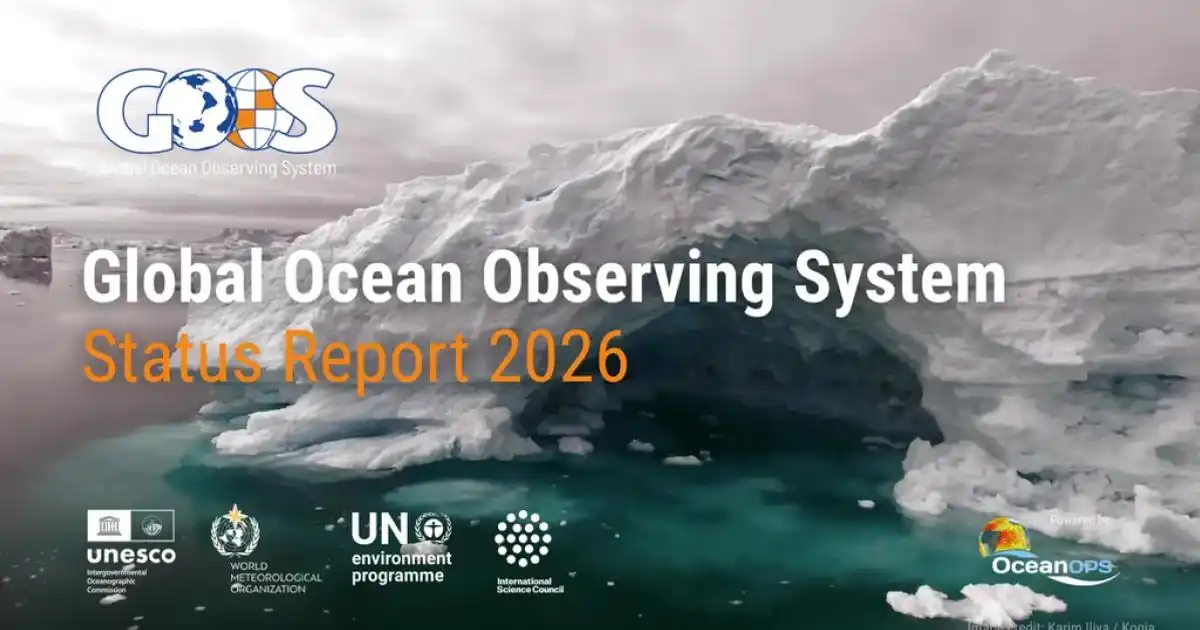
Released today, the 2026 GOOS Status Report provides an interactive overview of the status of the system, presents new statistics on national contributions, and showcases the societal value of marine and ocean observations through impact stories from around the globe.
Today, 67 countries contribute to physical and biogeochemical observations at sea through 17 GOOS observing networks monitored by OceanOPS. Satellites complement these measurements with observations from space, while a diverse community of initiatives collects vital data on marine life and ecosystems. Together, these observations underpin weather forecasting, climate monitoring, maritime and coastal risk management, biodiversity conservation, and sustainable ocean economies.
“Without ocean observations, we are flying blind. They underpin weather forecasts and our understanding of the climate system, and helped us predict the development and strength of this year’s extraordinary El Niño. Ocean observations are a global public good, and our investment priorities should reflect that shared benefit,” said Celeste Saulo, WMO Secretary-General.
Critical Global Ocean Observing Gaps Remain
The global ocean observing system continues to make progress, supported by established global arrays, long-term reference observatories, regional systems, and emerging technologies. Yet, important gaps and risks remain. Observing capacity is unevenly distributed around the world, and many networks face challenges in securing the sustained funding needed to maintain and expand their observations.
Sustained implementation remains concentrated among a relatively small number of major contributors, particularly the G7 countries and Australia. Improved long-term coverage is critically needed in the Southern Ocean, polar regions, boundary systems, marginal seas, the deep ocean, and many coastal areas, particularly in developing countries and Small Island Developing States (SIDS).
“Strengthening the Global Ocean Observing System is not just a scientific challenge; it is a governance challenge. We need an optimized system that countries can sustain over time, and this will only be possible with stronger investments and closer cooperation with governments,” said Vidar Helgesen, Executive Secretary of IOC.
Strengthening coordination, improving data sharing, and broadening international participation will be essential to build a more comprehensive, resilient, and sustainable system. Continued investment and stronger collaboration across countries and observing communities are crucial to ensure that observations can meet growing scientific, operational, and societal needs.
“When the observing system is not effectively aligned on national, regional, and global levels, value is lost. Efforts may be duplicated, gaps remain unaddressed, and data does not reach those who need it. Strengthened coordination is therefore the first necessary step at all levels. Those providing that coordination must be empowered by political will to do so,” said Joanna Post, Director of GOOS.
Explore the 2026 GOOS Status Report
Discover:
- Latest updates and metrics from the 17 GOOS observing networks, including an interactive map with platforms and reference observatories deployed by each country;
- How the global ocean observing community is filling crucial climate monitoring gaps in the polar oceans;
- Practical tools for Pacific community resilience against rising seas, enabled by data from marine and ocean observations;
- How coral and algae observations are informing global coral reef monitoring and restoration efforts;
- A new International Alliance to support and strengthen GOOS, led by the EU and Canada;
- A fascinating example of global ocean observing community collaboration in recovering a lost ocean glider at sea.
Access the interactive report here: https://www.ocean-ops.org/goosreport/2026/