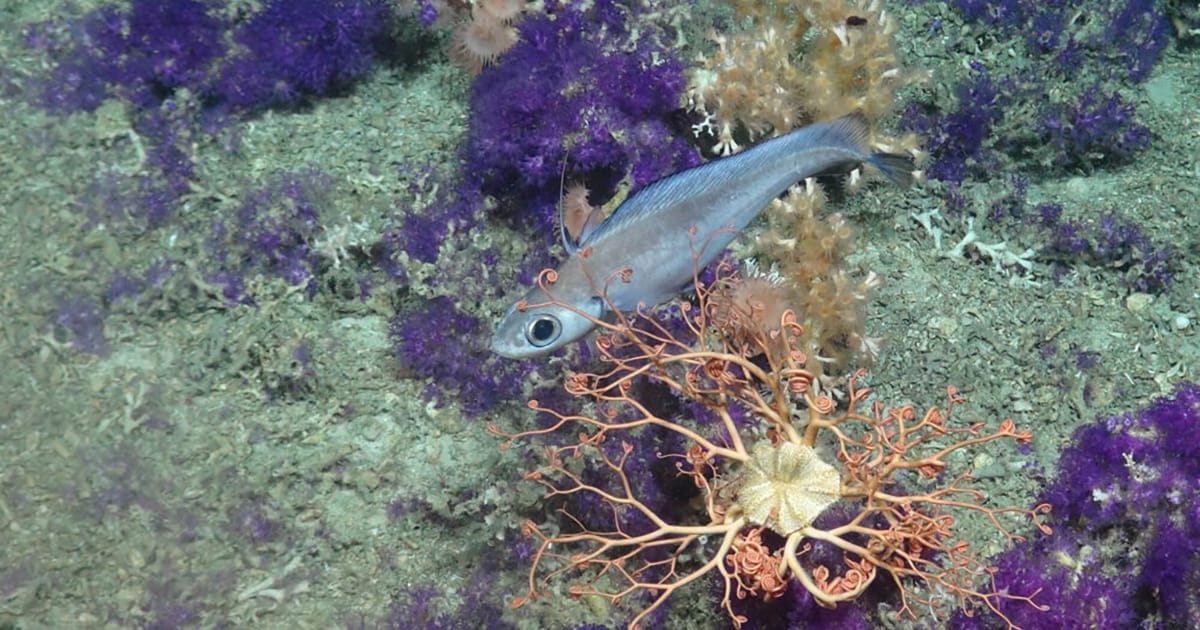
By systematically processing nearly 19 million records from the Ocean Biodiversity Information System (OBIS), the study reveals that global marine biodiversity data from below 30m are heavily biased towards:
- Shallow waters (50% of benthic records come from just the shallowest 1% of the seafloor)
- The Northern Hemisphere (over 75% of records)
- Vertebrates, namely fish
The study ‘Prioritisation of ocean biodiversity data collection to deliver a sustainable ocean’ was led by Dr. Amelia Bridges from the University of Plymouth and Prof Kerry Howell from Plymouth Marine Laboratory and the University of Plymouth, and was published in Nature Communications Earth & Environment.
What biodiversity data is missing?
Vast areas of the deep sea, particularly in the southern hemisphere and Areas Beyond National Jurisdiction (ABNJ), remain under-sampled. Invertebrates—despite making up the bulk of ocean biodiversity—are also poorly represented.
Biodiversity data underpin everything from habitat protection to climate impact modeling. The current data gaps mean that scientific models and management plans risk being skewed, trained on better-known regions and taxa while overlooking some of the most threatened and least studied parts of the planet.
To elucidate these patterns, the researchers developed a novel pipeline that separates benthic (seafloor) and pelagic (open-water) data – an important but often overlooked distinction. While the technical achievement is notable, the real story here is what the cleaned data reveal: a global call to action.
The authors urge future sampling to focus on four key priorities:
- The deep ocean (>1,500 m)
- The southern hemisphere
- Invertebrate taxa
- Remote areas beyond national jurisdiction
This work is a major step forward in turning biodiversity ‘big data’ into meaningful insight, with the datasets and code serving as a resource for researchers, policymakers, and conservationists working to meet the goals of the UN Decade of Ocean Science and the 30×30 biodiversity target.
Dr. Bridges, lead author on the study, commented: “Our findings show just how uneven our knowledge of ocean life really is, and that has major implications for how we protect it. If we want to manage the ocean sustainably, we first need to understand where life exists, and right now, we’re working with an incomplete map.”
Prof Howell, senior author on the paper and Deep Sea Ecologist at Plymouth Marine Laboratory, added: “This research will now help guide the work being done under the UN Ocean Decade Challenger 150 Programme, a global cooperative of deep-sea scientists whose aim is to map life in the deep ocean to support sustainable management. We now know where the gaps are and can focus our efforts on filling them. It’s a first step toward building a more balanced, global understanding of marine biodiversity.”