The scientists at the Scottish Association for Marine Science (SAMS) in Oban, a partner of UHI, have combined data from a range of sources to measure the mass formation of Atlantic currents, known as the Atlantic Meridional Overturning Circulation (AMOC).
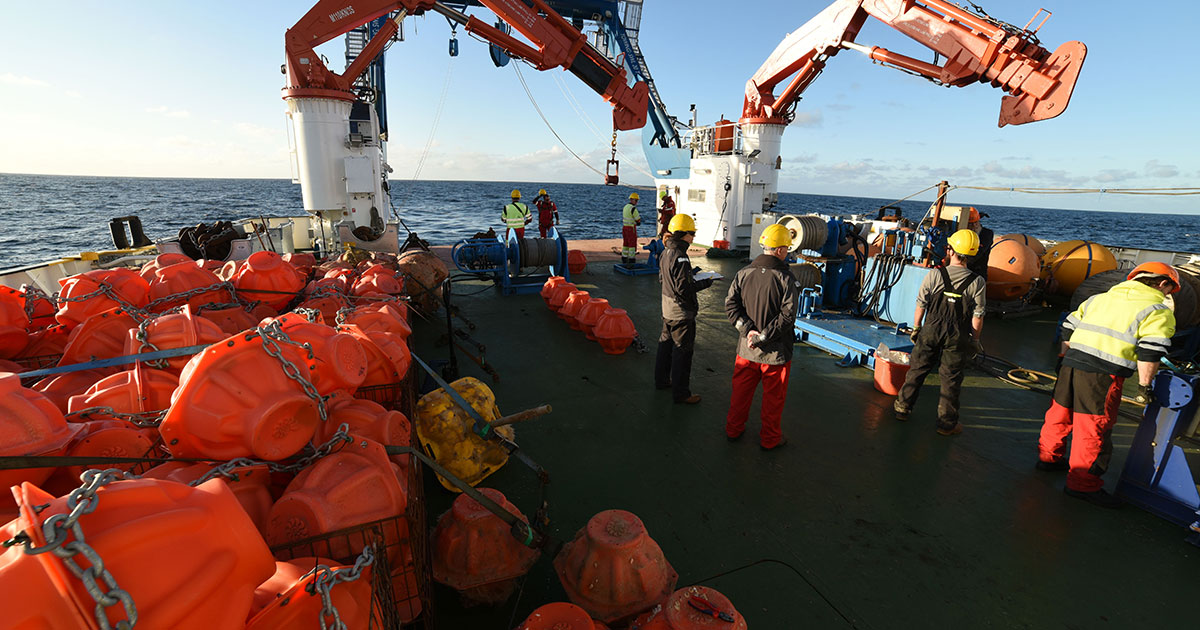
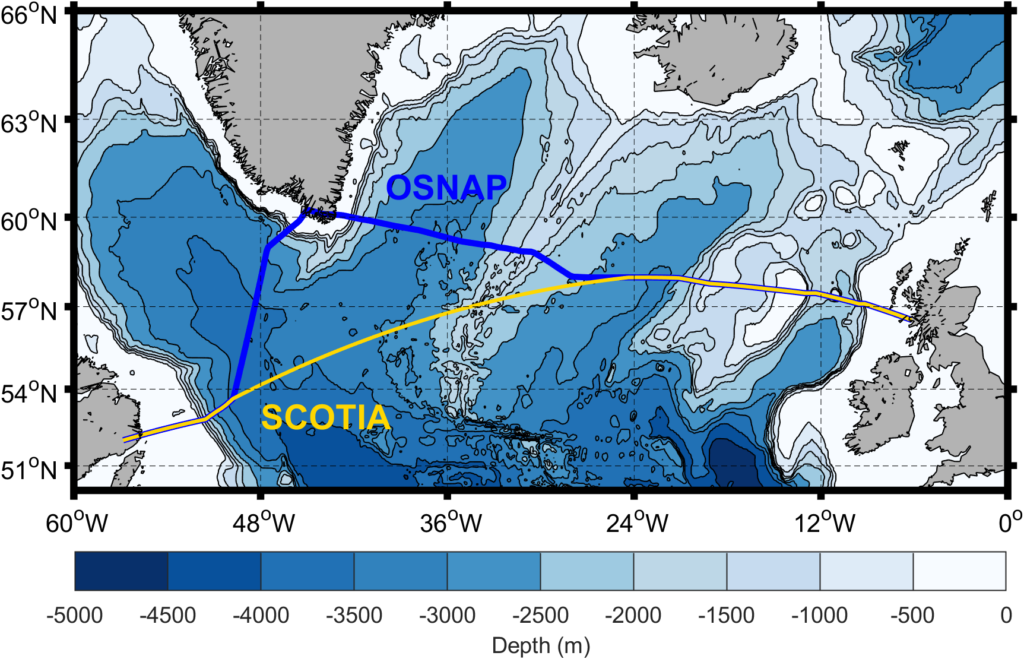
Their Scotland-Canada Overturning Array (SCOTIA) of observations incorporates data from scientific moorings on the existing subpolar OSNAP array and the 50-year Extended Ellett Line time series, as well as Argo floats drifting in the Atlantic. Data from the new array, which stretches from Scotland to Canada, also pre-dates OSNAP (established in 2014) by 10 years, giving observations from 2004–2024.
The findings have been published in a new paper in the journal Ocean Science.
Oceanographers across the world have long hypothesized that the AMOC could be weakening because of climate change, a view partly supported by a sub-tropical array of moorings known as RAPID, which has been in place since 2004. Because AMOC transports heat northwards from the tropics, a weakening or complete collapse of this ocean system could potentially plunge western Europe into freezing temperatures more commonly associated with higher latitudes such as Greenland and Siberia.
Project lead Dr. Neil Fraser of SAMS said SCOTIA had shown no clear signal that the AMOC was weakening at sub-polar latitude, but added this did not necessarily mean there was no overall weakening over a longer period of time.
Dr. Fraser said: “The creation of the SCOTIA array and the methods we used to gather this data mean we are a step closer to answering one of the biggest questions in ocean science: is the AMOC weakening? It will allow us to effectively keep our finger on the pulse of the AMOC to give us the best chance of detecting a weakening or collapse.
“By extending the record backwards by 10 years, we have brought the subpolar observations in line with the sub-tropical observations and can therefore better understand AMOC behavior across the Atlantic.
“Crucially, we have observations from the Labrador Sea, east of Canada, where the dense waters that sustain the AMOC engine flow southward.
“What we have developed is a cost-effective, sustainable approach to observing the AMOC that will help to future-proof research in this topic.”
The new SCOTIA array builds on the OSNAP array but adopts a different observational configuration, omitting measurements around Greenland. Instead, SCOTIA directly connects Ellett Line data on the eastern side of the Atlantic with mooring data from the western boundary that extends back to the 1990s. Argo float data are used to fill gaps across the central Atlantic.
The reduced mooring array design and use of Argo float data mean that getting a near-real-time AMOC estimate from SCOTIA is now a realistic ambition. This would give society the earliest possible warning if, or when, the AMOC does start to slow down, or indeed collapse.