
The mission was philanthropically funded by the London & Amsterdam Trust Company Limited, a Cayman-based organization that wants to leave a lasting legacy to the Cayman Islands.
Prior to the Saildrone survey, the Cayman Islands had limited data available on its EEZ; the extent to which the Cayman EEZ had been surveyed with modern multibeam sonar technology was only 20,000 sq km of seafloor concentrated around the deep water of the Cayman Trench.
For small island nations such as the Cayman Islands, ocean mapping unlocks critical opportunities in the Blue Economy: A high-resolution bathymetric map of a country’s EEZ is a prerequisite for exploring and managing natural resources in waters extending up to 200 nautical miles from its shores.
With the newly acquired seabed data, the Cayman Government will be better positioned to support:
- enhanced maritime safety, navigation, and charting
- sustainable fisheries
- offshore energy planning
- responsible seabed mining and marine mineral exploration
- conservation of vulnerable marine ecosystems and habitat management.
All raw bathymetric, backscatter, and ocean-profile data will now be handed over to the UK Hydrographic Office (UKHO), which will process data under its role as the Primary Charting Authority for the Cayman Islands, before the final data sets are formally delivered to the Cayman Government. The UKHO intends to update its nautical chart portfolio of the Cayman Islands by incorporating the collected data. Additionally, a low-resolution dataset will also be provided to Seabed 2030 to support its goal of mapping the entire global seabed by 2030.
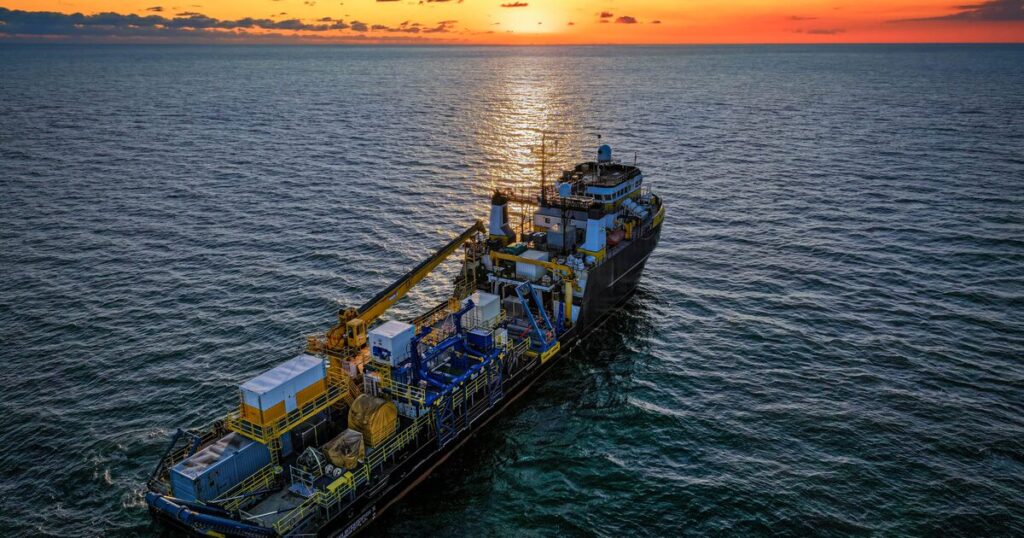
During the mission, Saildrone faced numerous operational challenges, including unprecedented sargassum blooms and severe weather threats, which exacerbated the operational difficulties of delivering high-resolution seabed mapping in the open ocean. However, these challenges also presented important opportunities to develop new techniques and tools for overcoming them. Saildrone responded with new approaches to clearing the sound velocity profiler (SVP) and enhanced remote diagnostics to detect biofouling early. Operating safely and consistently during severe weather helped validate the Surveyor’s proven capability to remain on survey up to sea state seven.
“This mission is a testament to the power of Saildrone vehicles in delivering ocean mapping at a scale and resolution that was previously prohibitively expensive for small island nations. Delivering mission-critical operations in sargassum-filled, hurricane-exposed waters demonstrates the resilience of Saildrone’s unmanned mapping services and the prospects it holds for nations worldwide,” said Saildrone VP Ocean Mapping, Brian Connon.