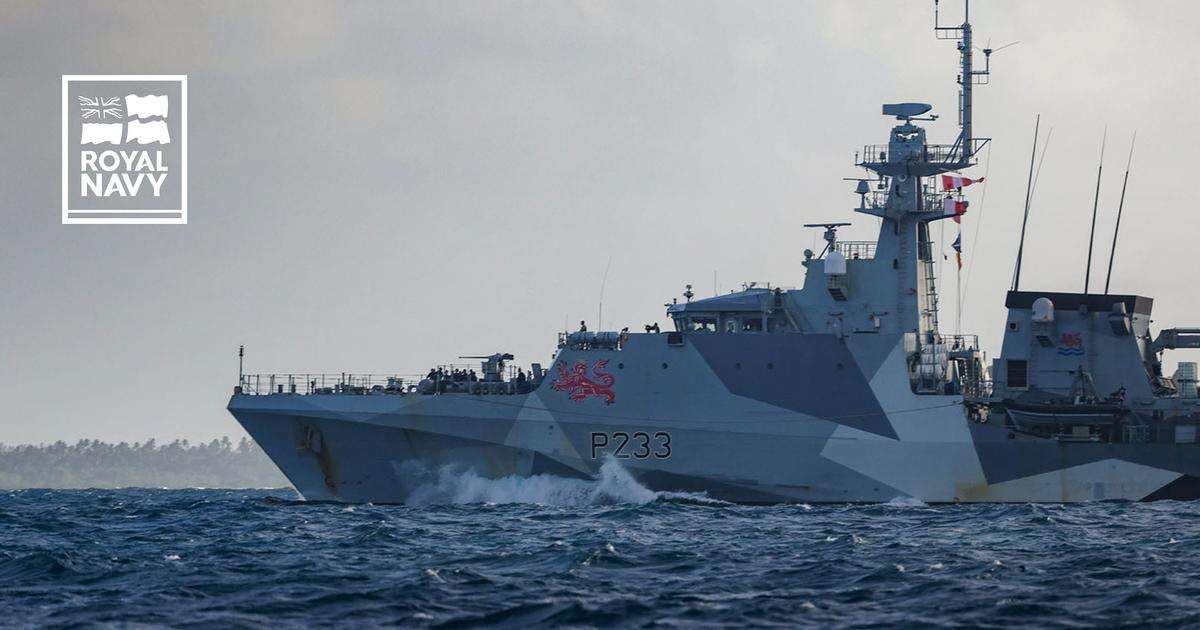
1,826 days have passed since sister patrol ships HMS Spey and Tamar—each crewed by around 50 sailors—left Portsmouth.
Since then they have renewed the Royal Navy—and UK’s—presence across the region, the first British warships operating around-the-clock in this key part of the world since the handover of Hong Kong in 1997.
The anniversary comes with HMS Tamar in Malaysia joining a major US Navy humanitarian deployment, Pacific Partnership, having spent a week forging ties with the Cambodian Navy and people.
The mission of the two ships—Operation Highwall—is about as wide-ranging as it gets, from participation in major international naval exercises to providing disaster relief and humanitarian aid after disasters, helping regional navies and authorities police their waters to prevent smuggling, drug-trafficking, or illegal fishing, and promoting military and economic ties with the UK.
They have helped to enforce UN sanctions imposed on North Korea by patrolling, conducting freedom of navigation missions in disputed waters, and exercising their rights under UN law to sail through international waters, sometimes individually, sometimes in company with regional allies.
They were also the first Royal Navy vessels to visit Cambodia in more than half a century.
On paper, the ships’ patrol area extends from the eastern seaboard of Africa to the west coast of the USA. More typically they are found in Southeast Asia/Australasia and the western Pacific Rim, with each vessel generally operating independently.
HMS Spey, which has taken part in 14 international military exercises since leaving Portsmouth, was pressed into action almost as soon as she reached the region, delivering aid—especially water—to Tonga after a massive underwater volcanic eruption and tsunami in early 2022.
Work by her navigational team also determined that the remote British Pacific Territory of Henderson Island had been incorrectly marked on official charts for more than half a century and was actually around one mile out of position.
Spey has spent 15,259 hours at sea—that’s 636 days—traveling 161,133 nautical miles in the process. Her younger sister Tamar is just behind her: 159,000 nautical miles and 15,000 hours at sea. Collectively, the pair have sailed nearly 15 times around the world in the past five years.
Of the 125 places visited by Spey, among the more remote/obscure are: Tahiti, Vanuatu, Timor Leste, New Caledonia, and a string of island chains (Pitcairn, Solomon, and Andaman).
To sustain themselves for so long thousands of miles from the nearest Royal Navy base, the ships have undergone maintenance in the ports and bases of our friends and allies in the Asia-Pacific region, especially Singapore—where HMS Spey is currently undergoing routine maintenance—and Cairns in Australia.
And crew changes take place every six or seven weeks (61 times in the case of HMS Spey so far), with personnel flying out from the UK to trade places with their shipmates so the vessels can maintain their demanding patrol schedules.
“Even though my ship has been on station in the Indo-Asia-Pacific for five years, we’re still forging new ground, such as our recent visit to Cambodia, which was the first time a British warship entered their newly constructed naval base,” said Commander Tom Lindsey, HMS Tamar‘s Commanding Officer.
Being deployed so far from home, Able Seaman Hart, one of HMS Tamar‘s gunnery team, misses her family and partner, although the Wifi set-up on board allows her to maintain regular contact and exchange photos with loved ones.
Tahiti has so far proved the most popular visit thanks to the combination of being somewhere most Britons won’t have visited, plus a vibrant nightlife.
Pitcairn Island—where the Bounty mutineers settled more than 200 years ago and which Tamar has called at twice—has been the standout visit as the epitome of a South Pacific paradise.
“It’s somewhere that few people will ever visit—and when the ship arrived, we doubled the population! While we were there, we got to pick fruits such as coconuts and grapefruits straight from the trees,” AB Hart said.
“My Nan comes from Thailand so it’d be great to visit there to be able to relate to all her great stories and to experience the authentic food.”
Lieutenant Jack Patterson, HMS Spey‘s navigating officer, also misses being away from his family (fiancée and cat) and home comforts like Irn Bru.
But the plus side has been experiences of a lifetime: visiting Hiroshima and picture-postcard Pacific islands.
“The lasting memory of my time on Spey is beginning a day when a new, exciting or obscure location not yet visited appears over the horizon,” he added.
His Commanding Officer, Commander Dan Briscoe, said everyone involved in the mission could feel proud of what the two ships have achieved.
He continued: “We’ve maintained a persistent presence over 8,000 nautical miles from the UK, with long logistical supply chains, delivering on operations, over 300 days at sea every year.
“And we have flown the Royal Navy and UK flag in a hugely important geopolitical region with very little other consistent UK footprint.”
Fleet Commander Vice Admiral Steve Moorhouse said sustaining the two ships so far from the UK was “a phenomenal achievement and a powerful demonstration of the Royal Navy’s ability to sustain a persistent presence at strategic distance.”
He continued: “HMS Spey and HMS Tamar have delivered effect far beyond their size—strengthening partnerships, upholding the international rules-based order while contributing to maritime security, UN operations, multinational exercises, sanctions enforcement, fisheries protection and much, much more.
They have been there when our partners needed them most: delivering humanitarian assistance and disaster relief following the Tonga volcanic eruption and tsunami and devastating cyclones in Vanuatu, while building the capacity and resilience of nations across the Pacific.
“Their crews have worked alongside allies, Commonwealth partners and regional navies in some of the world’s most remote locations, consistently turning presence into influence and relationships into operational effect.
“Their achievement is a testament to their professionalism, resilience and adaptability—and to the enduring value of a Royal Navy that is forward, persistent and ready to act.”