The scuttling off the coast of Destin-Fort Walton Beach, Florida, creates a rare opportunity to study ecological change in real time. Researchers, led by a team from the Woods Hole Oceanographic Institution (WHOI), will use the site to investigate how marine organisms colonize and form a biological community on large artificial structures.
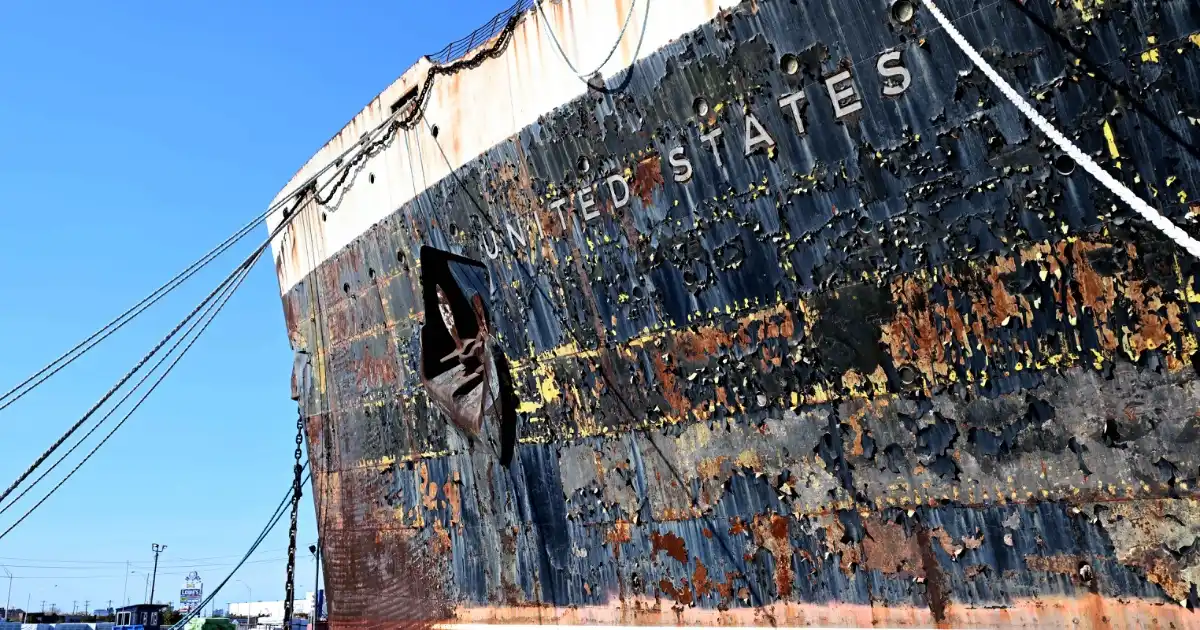
In 2024, Okaloosa County purchased the 990-foot SS United States with plans to deploy it as an artificial reef approximately 22 nautical miles southwest of the Destin East Pass in the Gulf of Mexico, creating expanded marine habitat in the northern Gulf while supporting the region’s fishing and diving industries.
The project is led by Okaloosa County’s Natural Resources team, who lead one of the nation’s most active artificial reef programs. “Destin-Fort Walton Beach has always been a place where people connect with the water,” said Alex Fogg, Natural Resources Chief for Destin-Fort Walton Beach. “Now we’re also leading in how we study and care for it. This reef shows that recreation, conservation, and science can work together, and that our community is serious about coastal stewardship for generations to come.”
Before deployment, the SS United States underwent extensive remediation, following the best practices set forth by the US Environmental Protection Agency, Maritime Administration, US Army Corps of Engineers, and Gulf and Atlantic States Marine Fisheries Commission. WHOI scientists will incorporate measurements of select elements and compounds into their broader sampling efforts, alongside ongoing studies of water chemistry, microbial activity, and biological colonization.
“This is an exciting opportunity to study and monitor the development of a new ecosystem,” said Kirstin Meyer-Kaiser, a marine biologist at WHOI, whose research focuses on how shipwrecks and other artificial structures shape ocean ecosystems. “This multi-year effort will show how a community takes shape over time, and how the physical and chemical transformations to a habitat influence the biological community. As humans expand habitats and infrastructure offshore, including wind turbines, oil rigs, and ships, they create surfaces and structures that allow microbes, corals, and sponges to settle and grow, often increasing biodiversity in ways natural reefs can’t.”
A separate microbe sampling mission focused on sediment and water surrounding the ship will be spearheaded by Leila Hamdan, a microbiologist at the University of Southern Mississippi, to show how the ship’s sinking affects the broader ocean environment.
Because the SS United States was intentionally deployed and extensively documented, scientists have a rare opportunity to track its transformation in real time. Within the first month, Meyer-Kaiser and her team will establish a baseline, documenting the ship’s physical condition, surrounding chemistry, and early biological communities.
“This is one of the first times researchers will be able to watch an ecosystem form from scratch,” Meyer-Kaiser said. “We can connect the chemistry, the microbes, and the larger marine life in a way that hasn’t been done at this scale before.”
Steel structures in the ocean naturally corrode, releasing metals such as iron, manganese, and nickel into surrounding waters. Researchers will collect water samples from 132 locations around the SS United States to measure these elements and understand how they shape the developing ecosystem. Many metals may act as micronutrients that support coral growth and health.
“We will be visiting the site annually to collect samples and photograph the site,” Meyer-Kaiser continued. “One of our long-term goals is to establish a citizen science program with Destin–Fort Walton Beach. Recreational divers could contribute their photos to help us build our dataset between annual sampling events.”
“Our role is focused on what happens after the ship is in the water, specifically, monitoring how the surrounding environment and marine ecosystem respond over time,” explained Colleen Hansel, a marine chemist at WHOI.
“Shipwrecks are more than artifacts; they’re ecosystems. Most of the time, we find them long after the ship sank, so the ecosystem is already mature,” Meyer-Kaiser said. “Understanding the controls on colonization of shipwrecks will also inform strategies for improving the effectiveness of artificial reef structures, including the design and engineering of materials that produce better artificial reefs and increase biodiversity.”
“Monitoring this site from square one can tell us a lot about this site, but it can also inform how we study shipwrecks in other areas of the ocean,” she concluded.