Launched in 2018, OceanHackWeek brings together marine scientists, oceanographers, and data scientists to explore contemporary challenges at the intersection of ocean science and data analysis. The program emphasizes open science, reproducible computing, and responsible data stewardship.
ASL Environmental Sciences’ Julek Chawarski, an alumnus of the inaugural OceanHackWeek in Seattle in 2018, led the initiative to bring the program to Canada.
“One of the greatest strengths of programs like OceanHackWeek is that they bring together expertise across subdisciplines of oceanography and fisheries, build a vibrant community, and rally participants around a central and vital component of research: collaborative and open science,” said Chawarski. “While we don’t expect folks to come out of this program with immense programming expertise, it gets participants closer to speaking the same language and, more importantly, recognizing the strengths of open computing tools in their research.”
The event was organized by a committee of Canadian and American scientists representing post-secondary institutions, government agencies, and nonprofit research organizations, including NOAA Fisheries, the Gulf of Maine Research Institute, the University of Washington’s Applied Physics Laboratory and eScience Institute, Ocean Networks Canada (ONC), and the Canadian Integrated Ocean Observing System (CIOOS) Pacific.
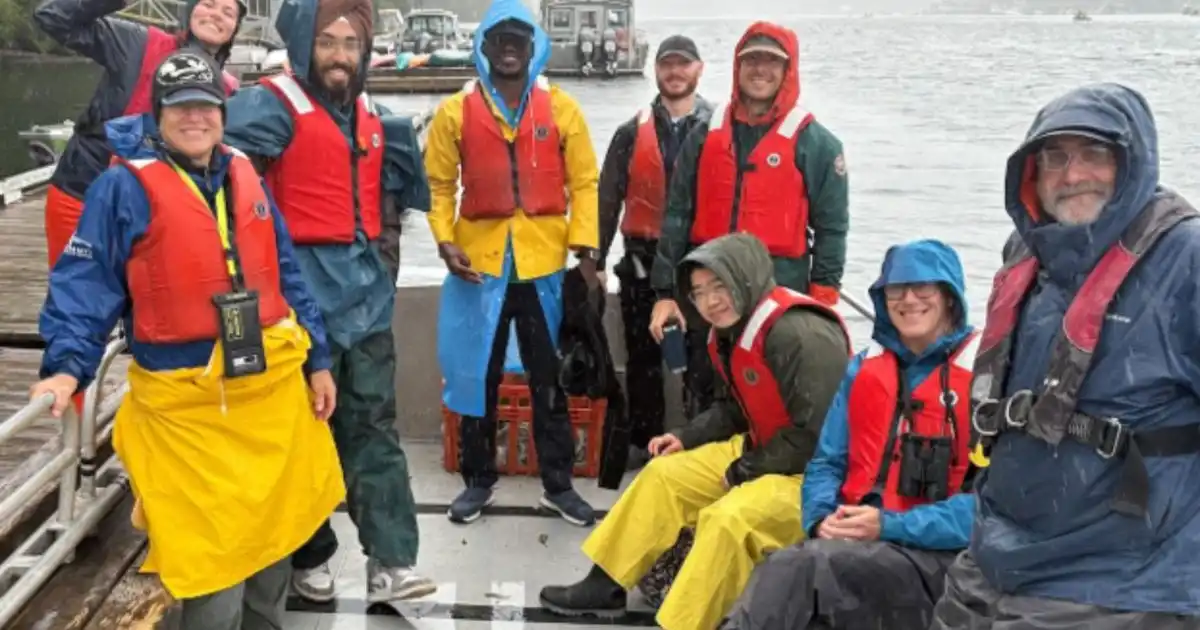
Organizers and mentors welcomed 22 participants from institutions across North America and abroad, ranging from undergraduate students to early-career professionals. The group also reflected a broad range of professional backgrounds, including research, defense, sales, and resource management. One participant described the experience as “one of the most interestingly diverse groups of folks I’ve ever gotten to interact with. I can’t articulate enough how welcome I felt.”
Unlike competitive hackathons, OceanHackWeek emphasizes collaboration and shared learning. Participants work in small groups to explore research questions and develop projects, with the week progressing from hands-on tutorials to collaborative project work. Sessions covered topics ranging from data visualization and storytelling to AI-assisted programming and deep-learning approaches to image analysis. Participants also exchanged ideas about technology tools, professional development, and mental health.
BMSC’s coastal setting added another dimension to the experience. Participants enjoyed sunny weather and explored the surrounding coastline and islands through tours led by BMSC’s foreshore team. These excursions offered opportunities to connect the computational side of ocean research with the infrastructure and environments that make it possible.
Participants also learned about nearby research infrastructure, including ONC’s NEPTUNE observatory, supported by a roughly 400-kilometer subsea fiber-optic cable, and the recently completed Pacific Ecosystem Autonomous Research Laboratory (PEARL). Both initiatives have received support from the Canada Foundation for Innovation.
Working with local experts, participants developed projects using data from these research systems. Their work explored data processing and interpolation, visualization, and opportunities to integrate complementary datasets from sources including CIOOS Pacific, Fisheries and Oceans Canada (DFO), the Copernicus Climate Data Store, and the European Space Agency.
BMSC’s campus, ocean views, and supportive staff provided a distinctive environment for collaborative learning. Being able to look out over the ocean while exploring the data and infrastructure underpinning marine research helped participants connect computational methods with real-world ocean science.