The workshop brought together 20 taxonomists and early-career researchers from across Latin America and Europe to examine deep-sea biological samples, primarily from the Schmidt Ocean Institute Underwater Oasis of the Mar del Plata Canyon expedition in August 2025 aboard Schmidt Ocean Institute’s research vessel Falkor (too), using the remotely operated vehicle (ROV) SuBastian. Hosted at the Universidad Maimónides in Buenos Aires from July 13–24, 2026, the team utilized integrated taxonomy techniques to rapidly identify specimens, logging discoveries directly onto Ocean Census NOVA, the world’s first open-access data platform for newly discovered marine species.
A standout discovery of the workshop, this striking deep-sea holothurian (sea cucumber) was named “Loki” for its prominent horned appendages, reminiscent of the god in Norse mythology. Captured in high-definition in situ video and images on the seafloor of the Mar del Plata Submarine Canyon, it represents one of up to 10 new holothurian species uncovered during the Argentina workshop.
Among the key findings was “Loki the Sea Cucumber” (Peniagone sp.), a striking deep-sea echinoderm named for its horned appendages, resembling the god of Norse legend. In total, the team identified 20 new species of copepods, 22 echinoderms (sea cucumbers and crinoids), 14 cnidarians (octocorals, sea pens, and stony corals), and one scaphopod mollusk, with five new scientific genera spanning corals, sea cucumbers, and crustaceans.
“International cooperation in taxonomy is critical, especially in groups with few active specialists. The species discovery workshop accelerated species identification, the recognition of species new to science, and increased capacity building for local early-career taxonomists working on deep-sea fauna,” said Dr. Daniel Lauretta, Principal Investigator, CONICET, and the Museo Argentino de Ciencias Naturales.
Species Spotlights & Workshop Highlights
- “Loki the Sea Cucumber” (Peniagone sp.) Location: Mar del Plata Submarine Canyon | Depth: 2,577 meters. Taxonomist: Francisco Alonso Solís-Marín & Mariano Martinez. This holothurian (sea cucumber) was one of the standout new species identified during the workshop. Featuring remarkable in situ images and video captured on the seafloor, “Loki” represents one of up to 10 new holothurian species uncovered during the workshop.
- The copepod collection (Copepoda, Harpacticoida) Location: Argentina Deep Basin / Mar del Plata Canyon. Of these tiny and vital crustaceans, taxonomists examined just 10% of the collected samples during the workshop. Yet, remarkably, every specimen examined was a species new to science, yielding 20 new species and one new genus.
- Deep-sea corals & sea pens (Octocorallia, Pennatuloidea, Scleractinia) Location: Mar del Plata Submarine Canyon. The workshop identified 14 new species of corals, including two potential new genera and a potential new family (awaiting genetic analysis). Highlights include the sea pen Pseudumbellula sp. and the vivid orange-red octocoral Orstomisis sp., providing crucial data on habitat-forming deep-sea ecosystems.
One Year On: Building on the Schmidt Ocean Institute Underwater Oases of the Mar del Plata Canyon Expedition
Principal Investigator Dr. Daniel Lauretta examines deep-sea marine specimens during the international Species Discovery Workshop. Hosted by Universidad Maimónides in collaboration with Schmidt Ocean Institute, CONICET, and the Museo Argentino de Ciencias Naturales, the workshop brought together 20 taxonomists to process samples gathered from the Mar del Plata Canyon.
The workshop marks the one-year anniversary of the Schmidt Ocean Institute Underwater Oases of the Mar del Plata Canyon expedition (July–August 2025), led by Principal Investigator Dr. Daniel Lauretta aboard Schmidt Ocean Institute’s research vessel Falkor (too).
Explorations focused on the Brazil–Malvinas Confluence, where warm subtropical currents collide with cold, nutrient-rich sub-Antarctic waters to create an oceanographic crossroad of immense biological productivity. Operating in a submarine canyon nearly twice as deep as the Grand Canyon (exceeding 3,500 meters), the team used ROV SuBastian to broadcast live video feeds directly to the public.
Over four million viewers tuned in live to witness sprawling deep-sea coral reefs, fields of mushroom coral at 1,500 meters depth, including observing a bright orange seastar that captured global imagination for its resemblance to the cartoon character “Patrick Star.” Despite gaining global fame during and after the expedition, “Patrick Star” was not thought to be a new species and was left undisturbed and unaware of its notoriety.
“Discovering 57 new species and five new genera in just two weeks demonstrates the speed and power of collaborative taxonomy. The deep sea holds some of the least understood ecosystems on Earth. By bringing Latin America’s scientific expertise and international experts together with, as well as connecting them to the open-access Ocean Census NOVA platform, we are drastically accelerating our understanding of marine biodiversity,” said Dr. Michelle Taylor, Ocean Census Head of Science..
Regional Significance for Argentina & Looking Ahead to 2027
Beyond immediate species counts, the workshop represented a major investment in Argentine scientific capacity and regional biodiversity research. Physical specimens processed during the workshop, as well as historical samples from CONICET’s Talud Continental I–III expeditions, a series of deep-sea scientific expeditions conducted in 2012 and 2013 to explore the marine biodiversity off the coast of Buenos Aires Province, will be permanently housed in national institutional collections, including the Museo Argentino de Ciencias Naturales “Bernardino Rivadavia” (MACN) in Buenos Aires.
The initiative provided hands-on training for Early Career Researchers and students, allowing knowledge exchange between local and international taxonomic experts.
The full team of international taxonomists, regional experts, and early-career researchers assembled at Universidad Maimónides in Buenos Aires. Over two weeks, the collaborative team rapidly identified 57 new marine species and five new scientific genera from deep-sea samples, logging their findings directly to the open-access Ocean Census NOVA platform.
“The Mar del Plata Canyon expedition captured the public’s imagination when we first live-streamed Argentina’s deep-sea, discovering potential new marine species,” said Dr. Jyotika Virmani, Schmidt Ocean Institute’s Executive Director. “These results show the power when world-class technology and expertise meets international scientific collaboration. By identifying new species, these scientists have advanced our understanding of South Atlantic marine life and, via Ocean Census, ensured that this data is accessible globally.”
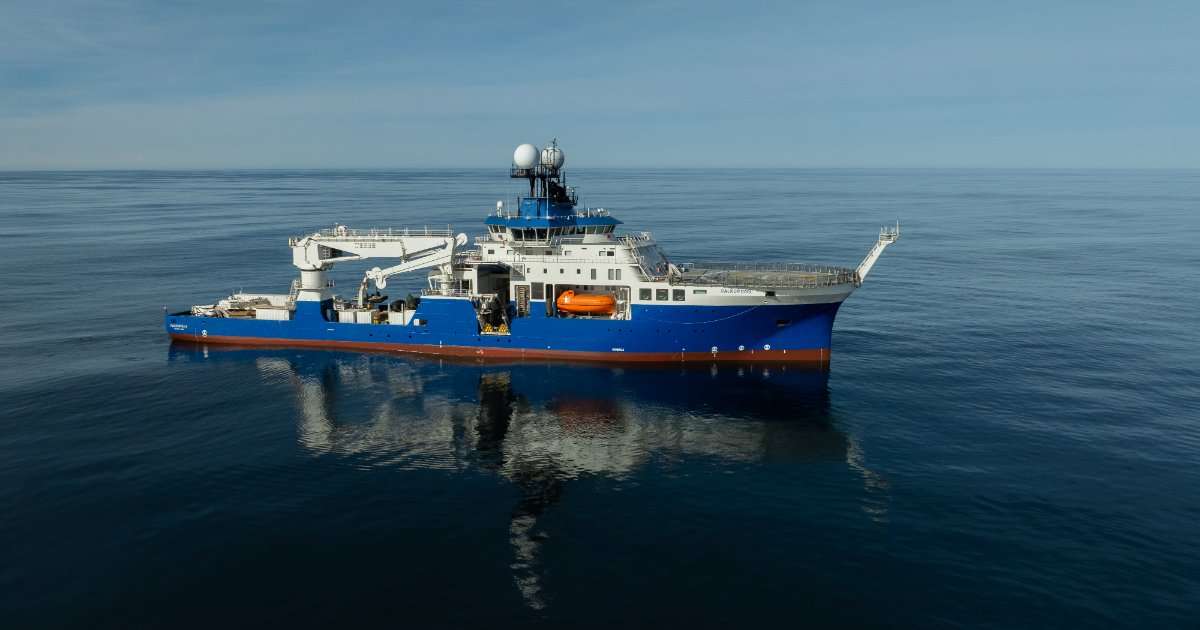
Schmidt Ocean Institute’s 110-meter state-of-the-art research vessel Falkor (too), which served as the operational mobile base for the August 2025 deep-sea expedition in Argentina’s Mar del Plata Canyon. The vessel enabled scientists to explore submarine canyons at depths exceeding 3,500 meters along the biological crossroad of the Brazil–Malvinas Confluence.
The discovery journey in the South Atlantic is far from over. Building on this success, Principal Investigator Dr. Daniel Lauretta and team are planning a follow-up expedition with Schmidt Ocean Institute in February–March 2027 to a different submarine canyon with anticipated high endemism. New samples of marine invertebrates collected during the upcoming expedition will potentially yield more new species and genera, necessitating further collaborative species discovery efforts, such as the recent Species Discovery Workshop.