
The team was surveying the abyssal seafloor near Davidson Seamount with MBARI’s remotely operated vehicle (ROV) Doc Ricketts, approximately 3,277 meters (10,751 feet, or roughly two miles) underwater, when they observed the bigfin squid emerging from the dark. This sighting is the first confirmed live observation of this elusive squid in the Northeastern Pacific Ocean.
“Every dive into the deep brings an opportunity to see something new. You never know what you’ll encounter,” said MBARI Postdoctoral Fellow Olívia Soares Pereira. “I was sitting right next to the screens in the control room when I saw what looked like tentacles coming into the top corner of the video. I thought it might be a cool jelly, but as soon as the little ‘elbows’ appeared, I knew exactly who this was and immediately screamed ‘Magnapinna!’ before the rest of the squid even came into the screen. It was incredibly exciting!”
The squid was hovering above the seafloor, undulating two large fins and trailing eight arms and two tentacles. Using a laser measuring system on ROV Doc Ricketts, the team estimated that the squid was approximately 1.25 meters (4.1 feet) long from the top of the body to the ends of the arms.
During the 10-day Seamount Hotspots expedition aboard RV David Packard, researchers from MBARI’s Benthic Biology and Ecology Team deployed a suite of diverse technologies to better understand the remarkable communities of life thriving on underwater mountains.
Seamounts are underwater mountains that rise from the deep seafloor. They deflect ocean currents, concentrating nutrients and food to support thriving communities of life on rocky slopes and in the waters above the summit. Located 130 kilometers (80 miles) southwest of Monterey, California, Davidson Seamount is a biological hotspot that is home to lush gardens of ancient deep-sea corals and a bustling deep-sea octopus nursery.
MBARI researchers were studying Davidson Seamount and its surroundings as part of a new research project to determine if mysterious furrows on the muddy seafloor were created by beaked whales feeding in the productive waters around the seamount.
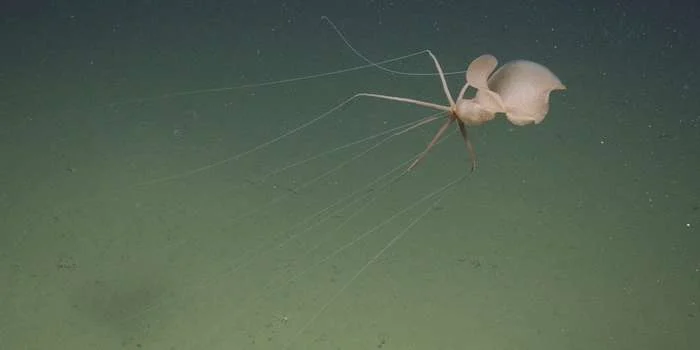
“I was focused on the seafloor and all of a sudden an elegant creature with undulating, angel-like ‘wings’ swam into view,” recalled Andrew DeVogelaere, a research ecologist with NOAA’s Monterey Bay National Marine Sanctuary and a longtime MBARI collaborator. “I was stunned—this is the first confirmed bigfin squid sighting in Monterey Bay National Marine Sanctuary and a powerful reminder of what we still have to discover in the ocean’s depths. We live next door to a magical place.”
Only about 70 bigfin squid have ever been observed or collected. This sighting is MBARI’s second encounter with Magnapinna. MBARI geologists previously observed a bigfin squid during an expedition to Hawaii in 2001.
This summer, Pereira participated in a Schmidt Ocean Institute expedition to the Doldrums Megatransform and Fracture Zone in the Atlantic Ocean that observed several bigfin squid.
“After this recent sighting, I texted another MBARI scientist from the Doldrums expedition, ‘How many Magnapinna will I see this year?’ I never thought I’d see enough of them to actually make that joke!” she said. “Each sighting is such a privilege and highlights the incredible diversity of life that thrives in the unknown deep underwater and needs our protection.”
The Seamount Hotspots expedition was made possible thanks to the David and Lucile Packard Foundation’s longtime support of MBARI’s work.