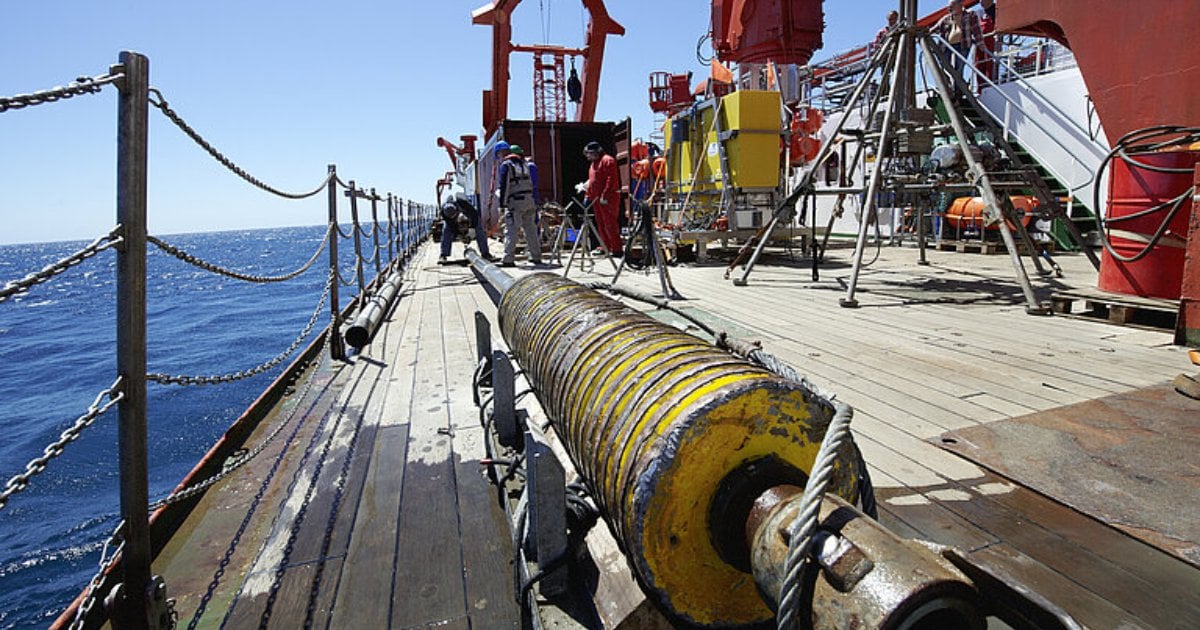
Do climatic changes influence volcanism on the mid-ocean ridges? An international research team led by the GEOMAR Helmholtz Centre for Ocean Research Kiel is investigating this question on the SO321 expedition aboard the research vessel SONNE. The team has now set sail from Vancouver, Canada, heading for the Cleft segment off the coast of the USA.
The mid-ocean ridges are the world’s longest mountain range and, at the same time, remain largely unexplored. They encircle the entire globe and stretch for around 65,000 kilometers. More than 90 percent of it lies in the deep sea, at an average water depth of around 2.5 kilometers.
Two tectonic plates are drifting apart along the mid-ocean ridges. As they do so, hot material rises from the Earth’s mantle, giving rise to new oceanic crust and underwater volcanoes. Much of the world’s volcanic activity takes place along the mid-ocean ridges. In the study area of the SO321 expedition—the Cleft segment of the southern Juan de Fuca Ridge—the plates are moving apart at a rate of five to six centimeters per year. Currently, the central fissure of the Cleft segment is 30 to 50 meters wide and 10 meters deep.
Over the past millions of years, sea levels have fluctuated repeatedly by up to 130 meters as a result of the growth and melting of ice sheets and glaciers. As sea levels rise or fall, the pressure on the seabed and the Earth’s interior beneath it also changes. Modeling suggests that volcanism along mid-ocean ridges responds to these pressure fluctuations.
However, the extent to which different climatic conditions actually influence underwater volcanism has not yet been sufficiently investigated. Previous studies have focused primarily on samples that provide information only over short time periods. Older sediments and volcanic rocks formed during past glacial cycles, on the other hand, are difficult to access as they have been buried over time by younger sediments.
“We want to study the sediments dating back to the Pleistocene epoch 1.5 million years ago,” explained Dr. Christian Timm, a marine geologist at GEOMAR and expedition leader for the first leg of the voyage. “This period was characterized by a recurring alternation of cold and warm periods and is therefore particularly well suited to investigating our research question. To do this, we are extracting sediment cores at close intervals at a water depth of around 3,000 meters using a gravity core sampler—these are cylindrical tubes up to 25 meters long that are driven into the sediment deposits on the seabed. In this way, we are obtaining information from layers that extend down to the basaltic basement.”
Sediment cores are archives of Earth’s and the oceans’ history. They contain, for example, fragments of volcanic glass and various metal compounds. These provide insights into how active volcanoes and hot springs on the seabed (known as hydrothermal systems) were in the past. To determine the origin of the metals in a layer, researchers compare the ratios of different forms (isotopes) of lead. These ratios act as a chemical fingerprint. If the isotopic signature in the sediments changes, this may indicate that the origin or mixing ratio of the deposited metals has changed as a result of volcanic input. The researchers aim to reconstruct whether and how the hydrothermal metal flux has changed over the past 1.5 million years, and whether these changes are linked to cyclical fluctuations in climatic conditions.
Volcanic glass, in particular, provides an excellent record of the magma’s original chemical composition. It also offers insights into how magma formation and the creation of new oceanic crust may have changed as a result of sea-level fluctuations. In sediment-free areas, freshly formed volcanic glass can be extracted using a so-called wax corer, which acts like a kind of stamp.
“Our expedition builds on a very solid data set from the study area, which was compiled last year during a joint expedition led by Harvard University and the Woods Hole Oceanographic Institution. During the expedition, the research team used the autonomous underwater vehicle (AUV) Sentry to create a detailed, high-resolution map of the seabed. This now provides us with information on where we can take our samples,” added Christian Timm.
Dr. Heidrun Kopp, Professor of Marine Geodesy at GEOMAR, is leading the second leg of this SONNE expedition. She said: “Investigating whether there is a link between climate and volcanism along the mid-ocean ridges can help us to better understand the interactions between the Earth’s interior, the ocean and the climate. If volcanic activity increases, the input of CO2, dissolved substances and trace elements into the ocean may also change. This can have an impact on the biogeochemistry and ecosystems of the ocean. Our findings can then also be applied to other sections of the global mid-ocean ridge system.”
Expeditions SO321/1 and SO321/2 are two of several expeditions to the mid-ocean ridges and form part of the large-scale European ERC Synergy Project T-SECTOR (Testing Solid Earth – Climate Connections). This project is dedicated to investigating the extent to which processes in the atmosphere, the ocean and the Earth’s interior are interconnected. In addition to the research groups led by Martin Frank, Heidrun Kopp and Kaj Hoernle from GEOMAR, Charles Langmuir from Harvard University (USA) is also involved in this project. Scientists from the University of Hamburg will also take part in the expedition.