Each day, we rely on resources sourced from the ocean floor. However, transporting these resources safely and efficiently from subsea wells to processing facilities at the surface requires carefully engineered systems.
Subsea risers are large pipes that carry resources from wells on the seabed to processing facilities at the surface. During operation, these pipes are exposed to external loads from waves and currents as well as internal loads from the fluids moving through them, known as flows. These loads create wear and tear known as riser fatigue.
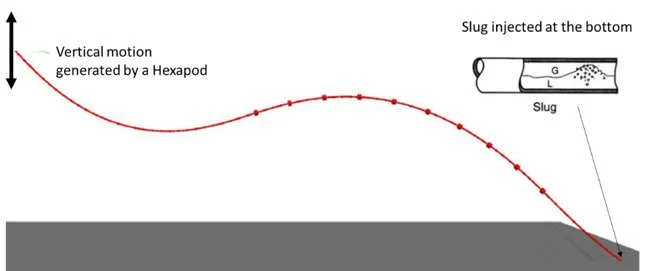
Riser fatigue is particularly prevalent when transporting a combination of gas, liquids, and solids, known as a multiphase flow. When gas and liquid travel together, the flow can form alternating liquid “slugs” and gas pockets. This is called slug flow. The resulting changes in pressure and momentum generate fluctuating forces in the riser, influencing fatigue at critical points on the pipe such as the hang-off, hog bend, and touchdown area.
Modernizing Traditional Engineering Practices
“Accurately predicting how the interaction of internal and external forces affects risers is crucial for being able to predict their lifespan. However, current engineering practice still contains considerable uncertainty, because the different load processes are often assessed separately and their fatigue contributions are then combined using simplified methods,” said Naiquan Ye, research manager at SINTEF.
Previous studies of simultaneous dynamic loading have shown that these simplified methods can grossly underestimate combined fatigue in some conditions, while other simplified approaches can be too conservative. Simply adding up the damage caused by each process separately is questionable in terms of physics and can underestimate the total damage that occurs when they act together.
More representative experiments are therefore needed to provide more reliable data for predicting fatigue.
Testing Slug Flow and Wave Fatigue Together
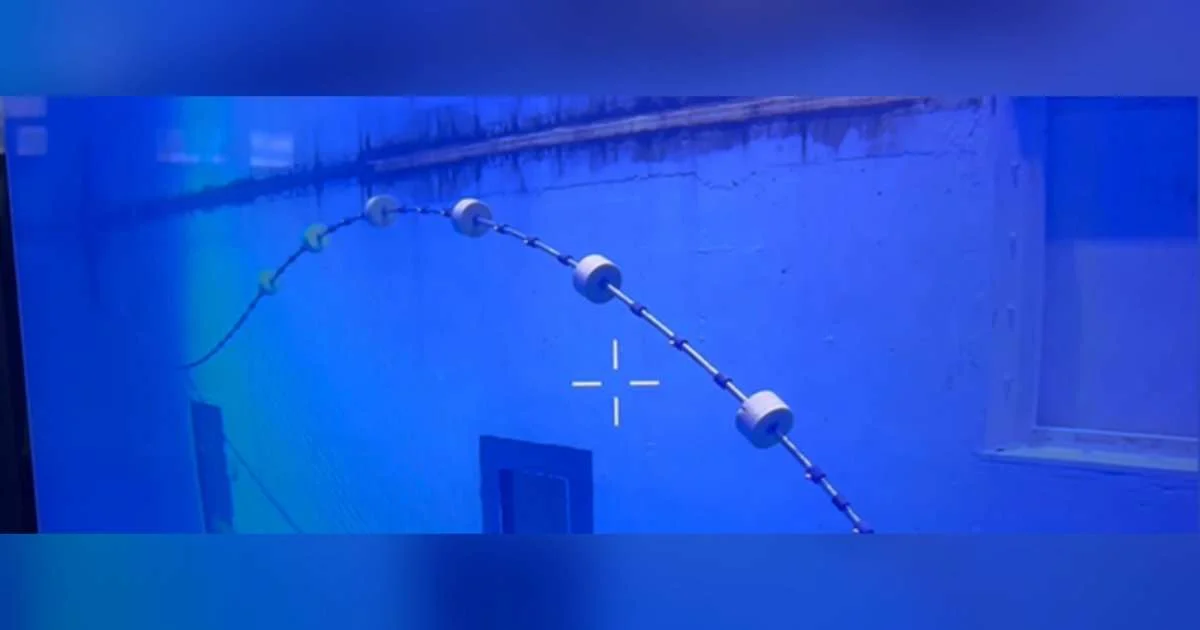
Researchers at SINTEF together with Equinor have found a way to more accurately predict riser fatigue. In the Ocean basin laboratory at SINTEF’s facilities, the project team built a scaled lazy-wave riser and completed three main categories of tests: pure slug-flow loading, pure wave loading, and combined slug-and-wave loading. This model allows the researchers to separate the pipe’s responses to the individual processes and then examine what changes when both processes act simultaneously.
Wave-induced motion was introduced through the test setup, while slugs were injected at the lower end of the riser. Sensors and cameras recorded the structural response and the internal flow. According to the project team, the scale of the model and the breadth of the combined loading program make the test one of the largest of its type in both academic and industrial testing.
Designed for Better Prediction Methods
A distinctive feature of the model setup was the transparent pipe. Cameras could therefore record the gas-liquid flows moving inside the riser while the model was in motion. Image processing converts the recordings into quantitative descriptions of the flow along the pipe, making it possible to relate what happens inside the riser to its measured structural response.
“The transparent model lets us observe the internal flow and the riser response at the same time. That is essential when we want to understand the interaction rather than treat the load processes as independent of each other,” explains Benjamin Smeltzer, researcher at SINTEF.

The experimental data provide a controlled benchmark for assessing numerical models. The project couples structural modeling in the analysis program RIFLEX with dynamic multiphase-flow modeling in the simulator LedaFlow. Comparing numerical calculations with the model-test measurements helps to determine how well the coupled modelling captures the mutual interaction between slug loads, wave-induced motion, and the riser’s dynamic response.
“The immediate goal is not to claim that all uncertainty has been eliminated, but to establish a stronger evidence base for model validation and further development. If the interaction can be represented more accurately, engineers can make better-informed decisions about new riser designs and more accurately predict the remaining lifespan of risers already in service,” said Smeltzer.
A Platform for Future Investigations
The experimental design and model testing were conducted by specialists at SINTEF within structural engineering, marine operations, experimental hydrodynamics, and process technology. The setup design process required multiple iterations in order to successfully integrate riser mechanics, multiphase flow, instrumentation, and image processing all into one experiment.
During a test demonstration in the Ocean basin laboratory, Equinor described the work as an impressive joint effort and highlighted the scientific and educational value of seeing full-scale principles of riser mechanics demonstrated so clearly.
“The preliminary results are encouraging and indicate that the experiments are consistent with theoretical results published with DNV last year,” said Guttorm Grytøyr, senior specialist in riser technology at Equinor.
The completed program focused specifically on slug-flow and wave loading. In future studies, the same methodology could be extended to more complex combinations, such as vortex-induced vibration, waves, and slug flow, working towards a more complete modeling of coupled riser and internal-flow dynamics.