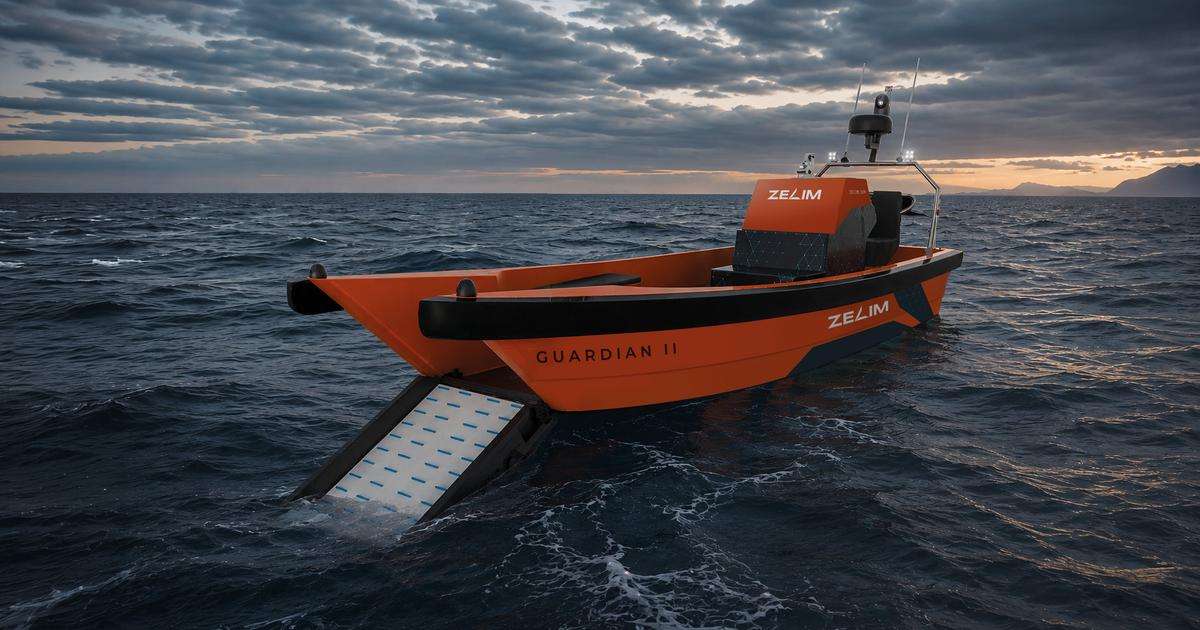
The company’s patented solution—a custom seven-meter rescue boat—has been developed with a choice of configurations available, including self-righting, single-point lift, and tailored options for propulsion, including diesel jet inboard, jet outboard, or electric.
Specifically designed for rapid deployment from a ship in under five minutes, the Guardian II can operate in maritime conditions that conventional manned recovery solutions would find challenging or too dangerous to deploy.
With max capacity of up to 15 survivors, the lightweight vessel also incorporates Zelim’s type-approved Swift rapid rescue conveyor and ZOE, Zelim’s automated, intelligent detection software for optimizing search.
Zelim is now in the process of gaining type approval for Guardian II under SOLAS (Safety of Life at Sea)—an official certification process confirming that marine equipment and safety products meet international technical and performance standards.
Zelim anticipates uptake of Guardian II in various potential formats across markets across all maritime industries from cruise, offshore, and commercial shipping sectors, to coastal rescue, defense, inland water, and leisure operations. With Zelim’s global presence, the company is well placed to provide an international support network for ongoing maintenance and training to the rescue vessel users.
Stewart Gregory, Chief Operating Officer, said: “With its range of potential configurations, Guardian II can be tailored to suit the requirements of a variety of markets and applications, from inland waterway light rescue to cruise lines and full oil and gas installations, as well as everything in between.
“Combined with our Swift system and a focus on remote helm operations, Guardian II is able to offer a fully integrated person-in-water retrieval system, with the capability to launch and recover the craft, unmanned.”
Sam Mayall, Chief Executive Officer, said: “Our next-generation Guardian II design addresses several critical safety challenges, including the inability to launch rescue boats in specific sea conditions due to crew risk, the high crew burden from manual handling, and the need for quicker and safer recovery of persons or objects from the water.”