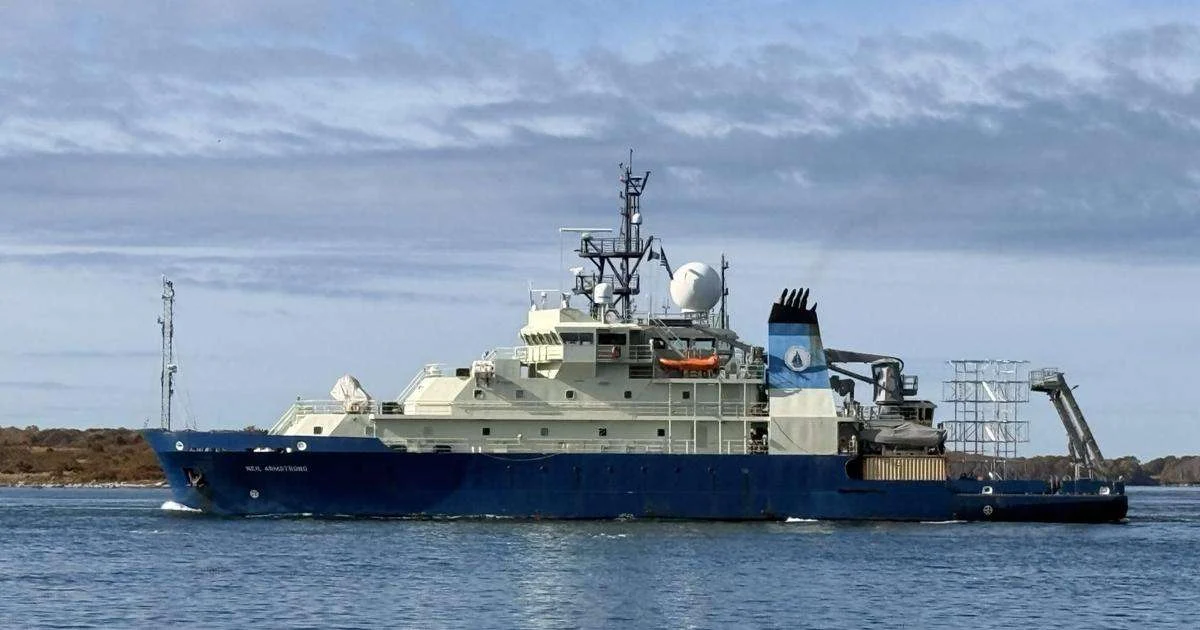
The Woods Hole Oceanographic Institution’s (WHOI) research vessel (R/V) Neil Armstrong departed its home port of Woods Hole, Massachusetts, on October 28 bound for Duluth, Minnesota, where it is expected to arrive around November 9. The 238-foot vessel will travel through a network of rivers, locks, and inland waterways on its 11-day journey to reach the far western end of Lake Superior, where it will support an effort to detect neutrinos in the lake’s natural water.
The project, known as the Experimental Neutrino Detector (END), is led by the University of Minnesota Duluth (UMD) and sponsored by the Defense Advanced Research Projects Agency (DARPA), in cooperation with the US Department of Energy’s (DOE) Office of Science, Fermi National Accelerator Laboratory (Fermilab), and Brookhaven National Laboratory. Neutrinos are subatomic particles that rarely interact with matter, making them exceptionally difficult to detect. Scientists study them to understand fundamental properties of the universe, such as why it is made mostly of matter rather than antimatter.
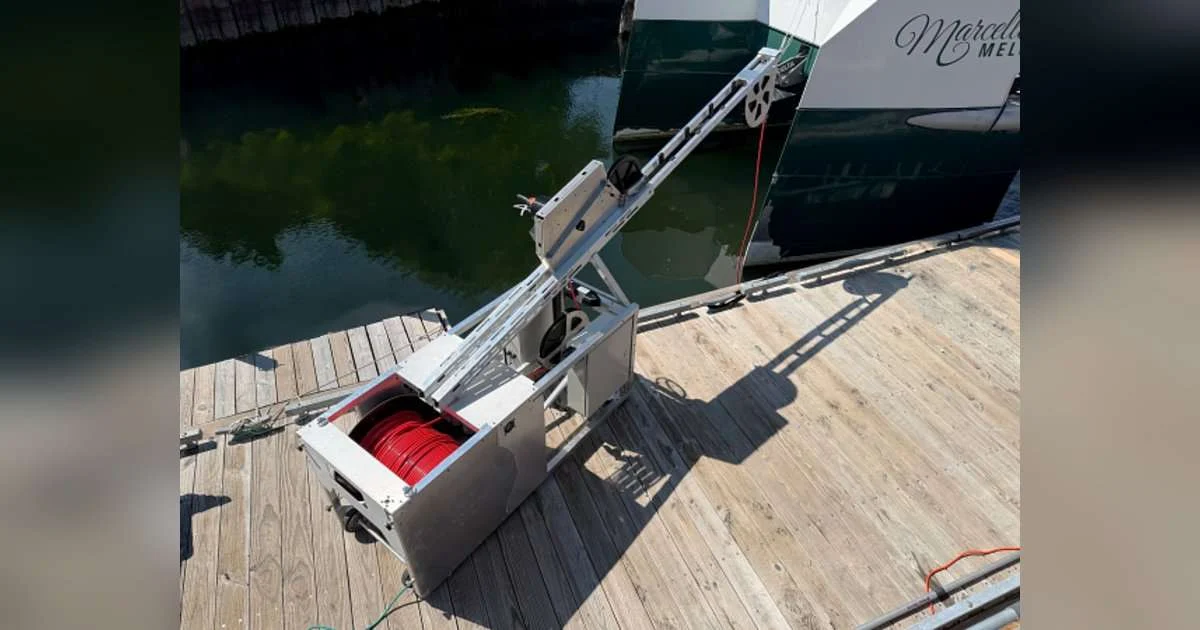
WHOI’s Mooring Operations and Engineering (MOE) Group led the design and assembly of five detector arrays that will support underwater sensors central to the research. Once in Duluth, Neil Armstrong and its crew will transport the equipment several miles offshore near Two Harbors, Minnesota, lower the frames onto the lakebed, and install fiber-optic cables connecting the detectors to shore. The frames, each approximately 30 feet tall and weighing about 8,000 pounds with mounted equipment, must be positioned with precision to support the experiment.
“Our team has spent months designing and fabricating the large frames that will support this project,” said John Kemp, group operations leader for WHOI’s MOE Group. “Getting these massive structures from Woods Hole to Lake Superior is a major logistical undertaking, but that’s only part of the challenge. Once on the lake, we’ll need to carefully lower each frame to the lakebed and precisely position them. Once each frame is positioned on the lakebed, we’ll deploy a dedicated underwater fiber-optic cable, several kilometers long, to connect that detector array to the shore station. This process will be repeated for all five frames.”
The deployment will bring together WHOI’s expertise in engineering, ship operations, and oceanographic research in a new freshwater setting.
“This voyage demonstrates how the capabilities developed to support ocean science can enable scientific discovery in other environments,” said Rob Munier, WHOI vice president for Marine Facilities and Operations. “This is not a typical journey for Neil Armstrong, but it reflects the versatility of the vessel and crew, and the expertise of the project team. We’re proud to help make this innovative experiment possible.”
An Unusual Journey Through the Great Lakes
Moving a large oceanographic research vessel from the Atlantic Coast to Lake Superior requires extensive route planning and coordination. Neil Armstrong will navigate connected waterways, rivers, and locks, each with its own operating requirements and distinct navigational challenges. The experience and preparation of WHOI’s marine operations team will be central to ensuring the vessel and its crew reach Lake Superior ready to support the planned science.
“Research vessels like the Armstrong are accustomed to operating in demanding conditions, but this trip has a unique set of challenges,” said Kent Sheasley, Neil Armstrong‘s Master and one of two captains leading the voyage. “We’re considering everything from differences in buoyancy between salt and fresh water to navigating narrow rivers and locks, wave dynamics, and the Midwest weather conditions we’ll encounter.”
“In addition to our own expertise, we’re also consulting with local ship pilots who navigate these areas all the time,” added Sheasley.
About R/V Neil Armstrong
R/V Neil Armstrong is owned by the US Navy, Office of Naval Research (ONR), and operated by the Woods Hole Oceanographic Institution. Funding for operations is primarily provided by the National Science Foundation and ONR. For END, the DARPA and DOE funding for vessel operations is another unique aspect of the project. WHOI operates Neil Armstrong as part of the University-National Oceanographic Laboratory System (UNOLS) network, a group of academic institutions and federal partners that coordinate access to research vessels and related capabilities for the US oceanographic research community.
This journey highlights the specialized role of the US Academic Research Fleet. Research vessels are more than transportation; they serve as floating laboratories, equipped with the people, technology, and operational capabilities needed to deploy scientific instruments, collect data, and sustain research in challenging environments.
The ship is named after famed Naval aviator and NASA astronaut Neil Armstrong, who was the first human to set foot on the moon. Armstrong’s childhood home is in northwest Ohio, not far from Lake Erie, where the ship bearing his name will pass on its way to Duluth.
Follow the journey with the R/V Neil Armstrong ship tracker.