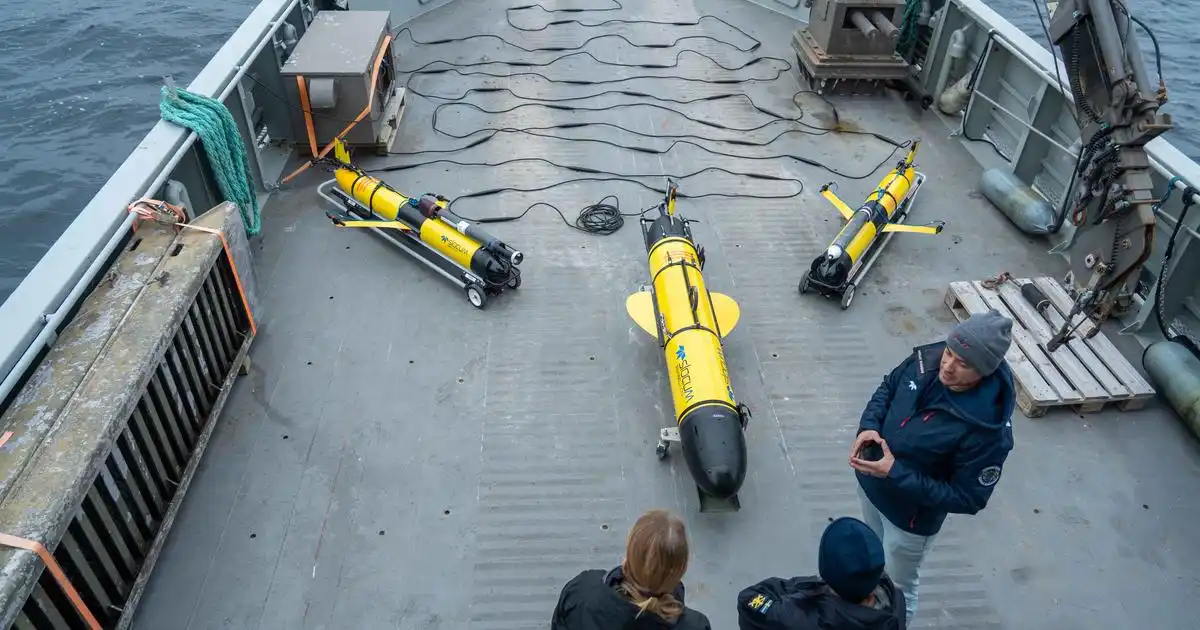
Two models of so-called gliders—the Slocum G3S and the Slocum Sentinel—were launched to demonstrate their functions and capabilities.
FMV planned and coordinated the demonstration together with Teledyne. After several days of testing, results were presented to invited representatives from the Swedish Navy and international guests.
“We wanted to give the Swedish Armed Forces the opportunity to test the vehicles under conditions typical of the Baltic Sea, including limited water depths. During the tests, we succeeded in both detecting a target vessel and transferring the information to a surface ship via underwater communication,” said Elin Nolander, engineer for marine sensor systems at FMV.
Gathering Information Below the Surface
Gliders are unmanned underwater vehicles that move by changing their buoyancy. Small wings convert the upward and downward motion into forward movement. This allows the vehicles to move with low energy consumption and collect information over extended periods.
During the demonstration, the focus was on passive acoustic detection using hydrophones and a towed array sonar (TAS). The technology makes it possible to record and examine sounds below the water’s surface without the vehicles themselves emitting sound signals.
The two models have different characteristics and sensor-carrying capacities. The tests gave the Swedish Armed Forces the opportunity to study how the platforms perform under Baltic Sea conditions.
Technology in Practical Use
For FMV, the demonstration was an opportunity to let the Swedish Armed Forces test the technology in the environment in which it is intended to be used.
“There is a big difference between receiving information about a product and seeing it used in the environment where it is meant to function. Through the demonstration, the Swedish Armed Forces gain a better basis for assessing the technology’s potential,” said Julia Lundkvist, systems engineer for autonomous underwater systems at FMV.
International Interest in the Tests
Among the visitors were international participants from Denmark, the Netherlands, the United Kingdom, and Germany. The demonstration thus also became an opportunity to showcase the technology in a Baltic Sea environment and build contacts with other stakeholders.
Demonstrating and evaluating new technology together with companies and international partners is part of the work to develop future naval capabilities. The interest from other countries shows that underwater surveillance and information gathering are issues engaging more stakeholders around the Baltic Sea and within NATO.
Facts: What Is a Glider?
A glider is an autonomous underwater vehicle that collects information below the water’s surface.
- Propulsion: Changes its buoyancy to move upward and downward. Small wings convert the motion into forward speed.
- Depth: Depending on model and configuration, it can operate at depths down to 1,000 meters.
- Endurance: Can remain at sea from a few weeks up to 18 months or longer, depending on model, batteries, and sensor equipment.
- Sensors: Can be equipped with, for example, hydrophones to record sounds underwater.
- Communication: Regularly surfaces to transmit data and receive instructions.
During the demonstration off Gotland, two models from Teledyne were used: the Slocum G3S and the Slocum Sentinel.