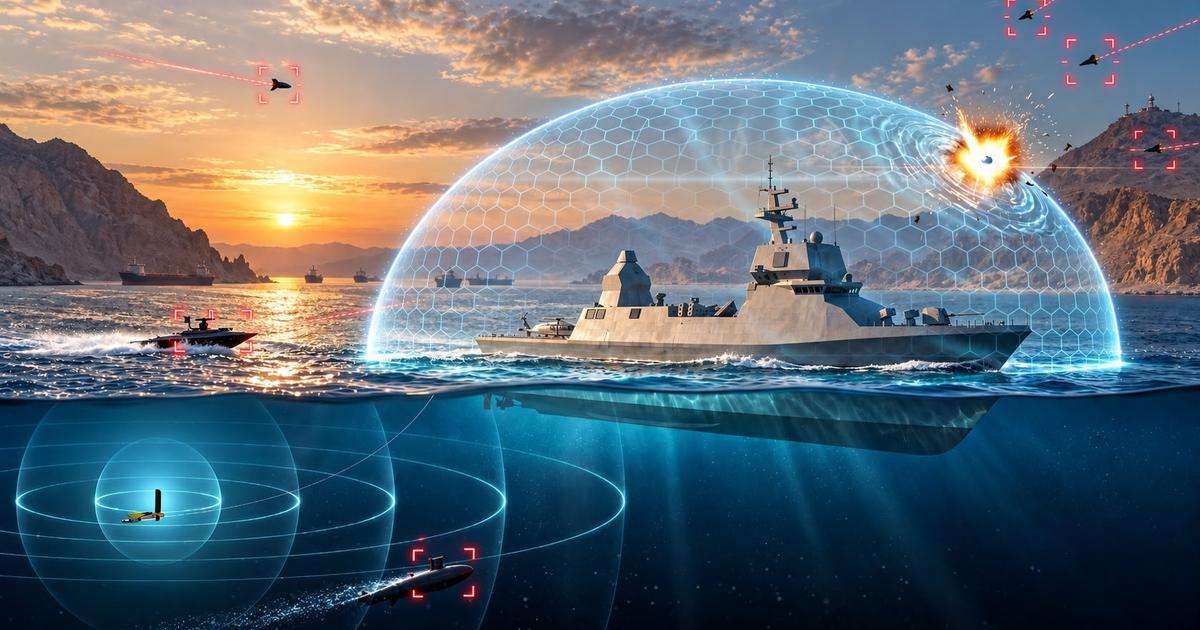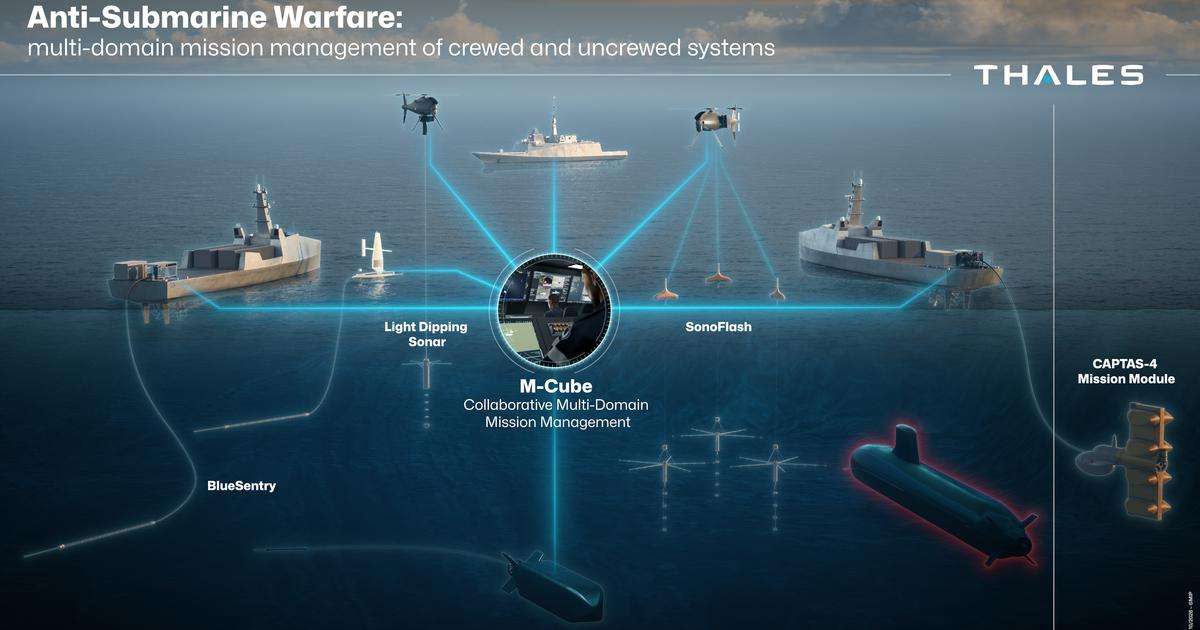
At Euronaval 2026, Thales highlighted three key innovations that bring this vision to life: M-Cube, the mission management system that enables collaborative operations across distributed assets; the new Lightweight Dipping Sonar (LDS), bringing advanced acoustic detection capabilities to autonomous and lightweight platforms; and the CAPTAS-4 Mission Module (C4MM), delivering world-class variable-depth sonar performance in a flexible, rapidly deployable format.
M-Cube: The Mission Management Backbone of the Hybrid Fleet
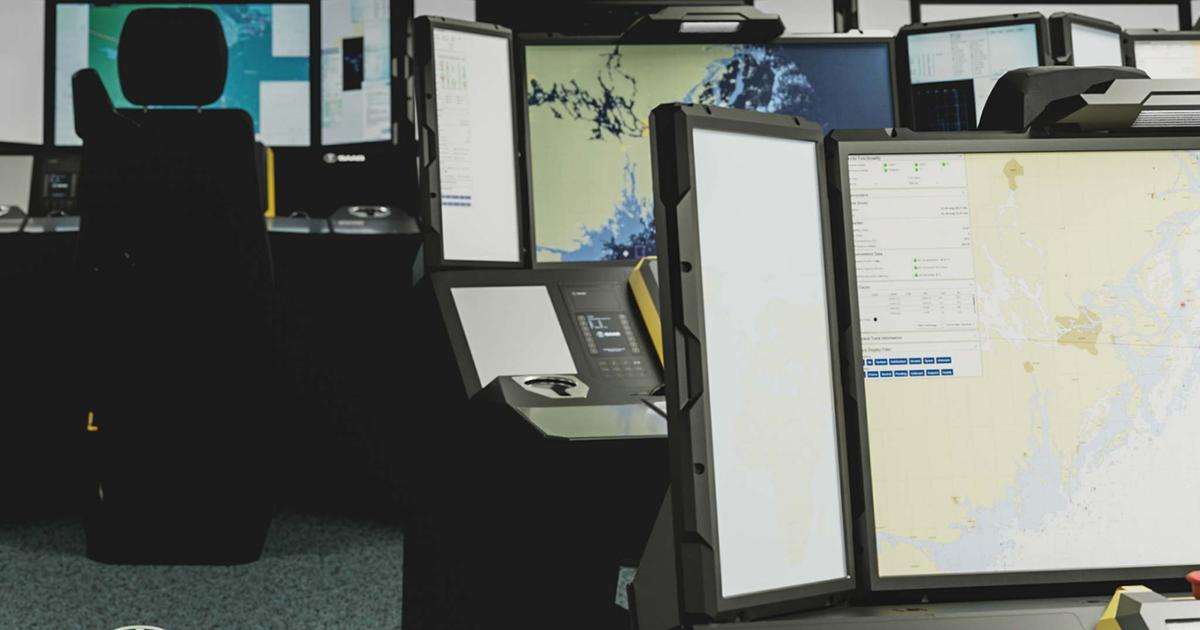
At the heart of Thales’ Hybrid Fleet vision, M-Cube provides the mission management and command-and-control framework required to coordinate complex operations involving crewed and uncrewed platforms.
Designed to support collaborative operations across multiple domains, M-Cube enables operators to plan, task, and supervise distributed assets from a single mission environment. By orchestrating the deployment of ships, helicopters, unmanned surface vessels, and other autonomous systems, it allows navies to conduct coordinated ASW operations over wider areas with increased operational efficiency and responsiveness.
Originally developed and proven in mine warfare missions, M-Cube is now expanding to ASW, ISR, and Above Water Warfare applications, providing a scalable and interoperable architecture aligned with NATO operational requirements.
Expanding ASW Reach with the Lightweight Dipping Sonar
The Hybrid Fleet vision also relies on multiplying the number of sensors available within the battlespace. To address this challenge, Thales is introducing its Lightweight Dipping Sonar (LDS).
Derived from decades of expertise in advanced sonar technologies, LDS extends high-performance acoustic detection capabilities to a new generation of autonomous and lightweight platforms. Compact, modular, and highly deployable, the system enables unmanned vessels and other non-traditional platforms to perform sophisticated underwater surveillance and submarine detection missions.
By allowing advanced sonar capabilities to be deployed further forward and for extended periods of time, LDS significantly enhances operational persistence while reducing risks to personnel and high-value assets.
CAPTAS-4 Mission Module: Frigate-Class ASW Capability, Unmatched Flexibility
Complementing this distributed architecture is the CAPTAS-4 Mission Module, which brings the proven performance of the world-leading CAPTAS-4 variable-depth sonar to a wider range of naval platforms.
Packaged as a modular, deployable, and cross-deckable capability, it offers maximum operational flexibility across a heterogeneous fleet. The CAPTAS-4 Mission Module enables navies to rapidly equip vessels with high-end ASW capabilities without requiring dedicated ASW frigates. This unprecedented flexibility allows operators to adapt their force structure to mission requirements while maintaining the level of performance needed to detect and track increasingly silent submarine threats.
By extending advanced underwater warfare capabilities across a broader fleet, CAPTAS-4 Mission Module plays a key role in enabling distributed and scalable ASW operations.
Shaping the Future of Underwater Superiority
These three innovations build on Thales’ growing portfolio of autonomous underwater warfare capabilities, including BlueSentry, a compact towed sonar payload designed for integration on uncrewed maritime platforms to provide persistent underwater surveillance and anti-submarine warfare capabilities.
“The future of Anti-Submarine Warfare is not about a single platform. It is about the ability to connect ships, autonomous systems, and advanced sensors into a coordinated operational ecosystem,” said Sébastien Guérémy, Vice-President, Underwater Systems, Thales. “Through these technologies, Thales is helping navies maintain decisive advantage in an increasingly contested underwater environment.”