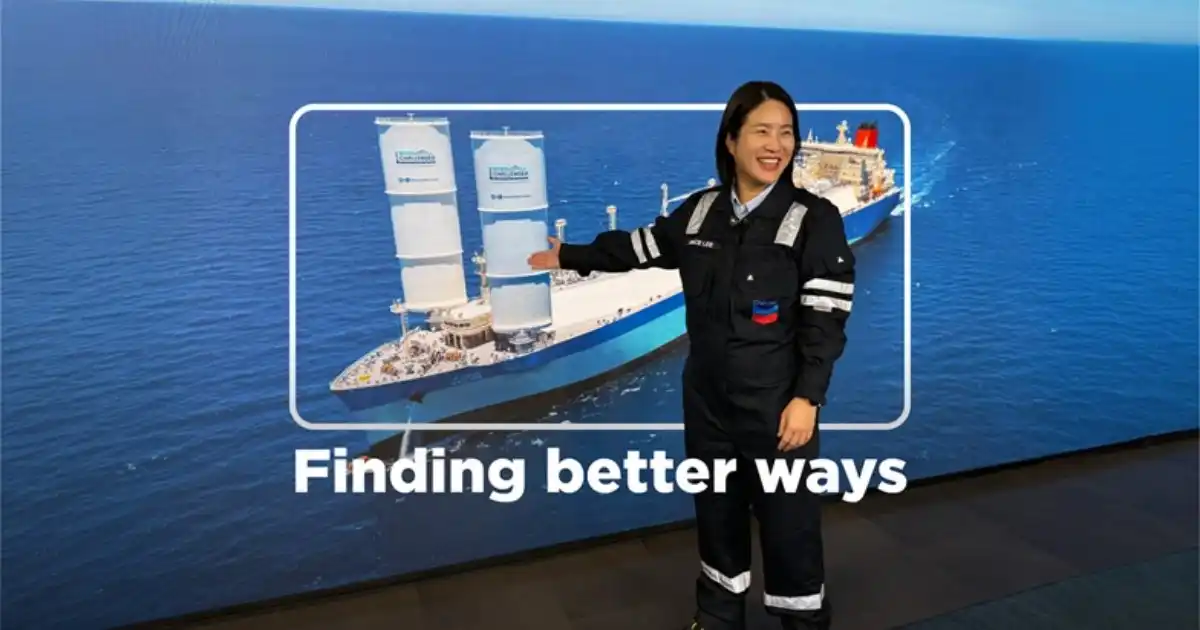
For thousands of years, ships have relied on wind to move across the water. Janice Lee, a Chevron senior hull and systems engineer, wanted to figure out whether that same force could help power modern energy carriers.
The answer to that question was yes—and Lee helped make it a reality with Fujin Sailor, the world’s first wind-assisted liquefied natural gas (LNG) carrier. It is also the first vessel of any type equipped with two Wind Challenger sail units. Lee says her team expects the add-ons to improve fuel efficiency, which will help lower the carbon intensity of the vessel.
Lee brought her experience as a naval architect and ocean engineer to the challenge. Her work centered on understanding how the technology would perform and on building the technical confidence needed to make it real.
Mitsui O.S.K. Lines’ Fujin Sailor was delivered to Chevron under a long-term charter in the fall of 2026.
“Putting sails on an LNG carrier sounds simple until you’re the first to do it,” said Lee. “Working closely with Mitsui O.S.K. Lines, we looked at many variables, including how the two sails perform together and the potential impact on vessel operations and crew safety, so we could move ahead with confidence. Now we get to learn from real voyages.”
Turning an Idea into a Working Vessel
The work began long before Fujin Sailor picked up its first LNG cargo in October 2026.
Chevron and Mitsui O.S.K. Lines (MOL) saw potential in applying wind propulsion to LNG shipping. Lee worked alongside technical experts from MOL and Hanwha Ocean, the shipyard that built Fujin Sailor, through design reviews, simulation, hazard assessments, and sea trials.
Her focus was understanding the technology in enough detail to evaluate how to safely harness the power of wind to advance LNG shipping.
That became especially important because Fujin Sailor takes the technology further. Earlier vessels equipped with a Wind Challenger system used one unit. Fujin Sailor has two.
The sails on the Fujin Sailor are 49 meters (more than 161 feet) tall. That’s a bit taller than the Statue of Liberty, from the statue’s base to the tip of its torch.
For Lee, that meant studying how the two sails interact aerodynamically and how that interaction could affect efficiency.
The engineering work also helped shape other practical aspects of the vessel. Technical reviews examined visibility, maneuverability, and maintenance considerations associated with the Wind Challenger system.
Each step added another layer of knowledge about how the technology could operate aboard an LNG carrier.
“The biggest challenge for me was understanding and predicting the performance for this new technology. We also had to consider how installing the system could affect vessel operation,” said Janice Lee, Chevron Senior Hull and Systems Engineer.
From Engineering Analysis to Real-World Data
Lee’s work did not end with sea trials.
Lee and her team will use performance monitoring to better understand how the Wind Challenger system performs under real-world voyage conditions. They will be looking at vessel and wind speed, power, and other operational factors.
As operating experience grows, Chevron, MOL, and the teams involved can build on what was learned through design, testing, and sea trials. They can also apply insights gained from real-world operating data to future operational shipping decisions.
The Fujin Sailor recently completed its first cargo voyage.
For Lee, the milestone brings together a career spent around ships. She studied naval architecture and ocean engineering in South Korea, began her professional career at a Korean shipyard, and later earned a master’s degree in ocean engineering from Texas A&M University.
Now that experience is helping her explore what comes next for shipping.
Fujin Sailor puts an ancient idea into a distinctly modern setting: using the wind to help move energy across the world more efficiently.