
The Edinburgh-based company is raising Pre-Series A funding to develop the technology alongside its existing offshore power business.
The move responds to a capacity problem facing the AI sector. Global demand for AI-optimized computing is set to quadruple over the next decade, according to the International Energy Agency, with AI data centers projected to consume 1,200 TWh a year by 2035, roughly four times the UK’s total annual electricity consumption.
Local opposition to new data center sites is a growing problem for the sector alongside constraints on land, water, and grid capacity, while energy costs remain the single biggest driver of data center economics. Many operators wait years for a grid connection and fall back on gas turbines just to get online.
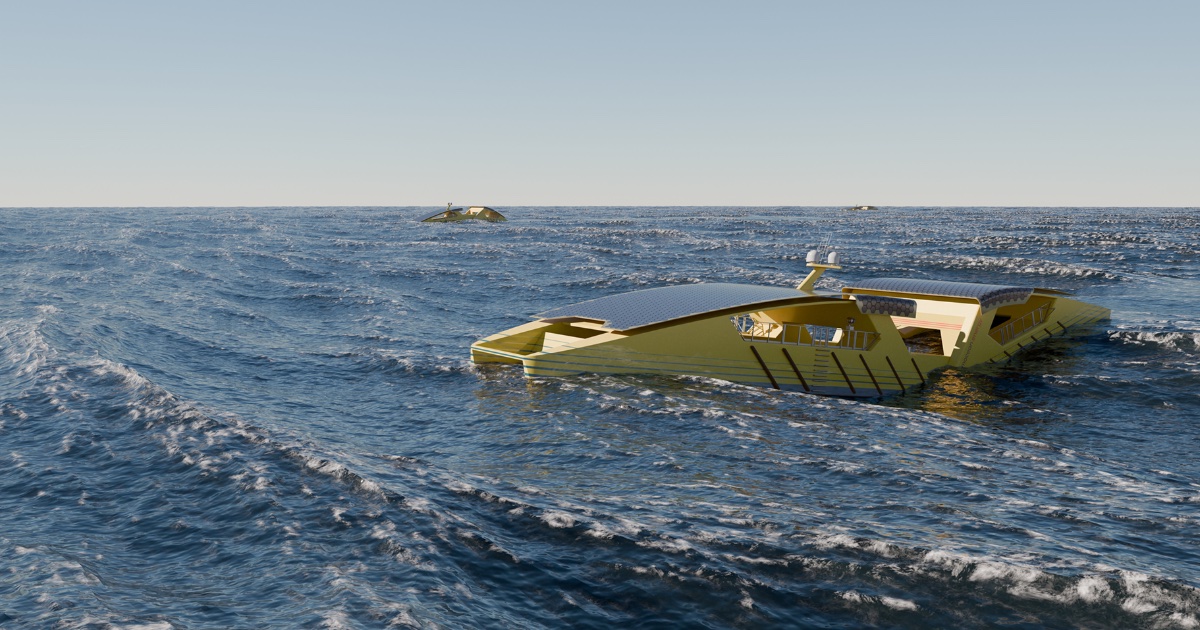
Blue Core is designed to remove those constraints by moving the data center out to sea. Each unit combines wave energy, offshore solar, and battery storage to power on-board AI server racks.
Each unit is connected via low-Earth orbit satellite communications, generates between 500 kW and 1 MW without a grid connection, and can be combined with other units to form farms. The system is designed primarily for AI inference workloads. Cooling, which typically consumes 15% to 35% of an onshore data center’s energy budget, is expected to account for around 5% at sea, using a closed-loop system that exchanges heat with the ocean rather than drawing on a community’s drinking water.
Cameron McNatt, Managing Director of Mocean Energy, said: “We’ve spent years proving this technology works in some of the harshest sea conditions anywhere in the world. Blue Core takes that same proven system and points it at a much bigger problem. AI data centers are going to need more power than the grid can easily give them, and the ocean can provide that.
“We’re not trying to build another data center. We’re trying to remove the barriers around power, land, and social licensing that are currently holding the industry back.
“Because Blue Core is built like an assembly line rather than a megaproject, units are manufactured and deployed one at a time. This means a single unit and a thousand-unit farm come from the same building block and any unit can be pulled out for maintenance or a GPU upgrade without disrupting the rest. When sited in national waters, the farms also provide sovereign infrastructure rather than a lease on another country’s cloud.”
Investment is already moving into ocean-based data center infrastructure. Microsoft’s Project Natick found an underwater data center was eight times more reliable than an identical onshore setup, and China already has an offshore data center in operation backed by around $226 million. Swedish wave energy developer CorPower Ocean raised €140 million in Series B and EU funding in 2025, while Panthalassa raised $140 million for a floating AI data center concept on the strength of the idea alone.
Y Combinator, the prestigious US accelerator behind Airbnb, Stripe, and Coinbase, has now put its own weight behind the idea, naming “Compute at Sea” among its latest Requests for Startups.
Blue Core builds on Blue Star, Mocean’s existing offshore power system, which has completed 18 months of full-scale testing in harsh sea conditions with international offshore energy companies and technology developers, including several energy supermajors. The two systems share the same core technology—power conversion, mooring, and controls—proven across a decade at sea. Mocean has secured a further Blue Star pilot, with first sales forecast for 2028.
Mocean’s roadmap targets its first Blue Star sales in 2028. In parallel, Blue Core is expected to deliver its first offshore demonstrator and begin early commercial deployments from 2030, working towards a ten-year target of 6 GW—roughly 2% of projected AI data center demand. Once a unit is built, its power is effectively free for the life of the asset, and Mocean estimates the approach could save around 13 million tonnes of CO2 a year by 2035.
The current £5 million funding round is supported by £2.8 million of non-dilutive funding already secured.