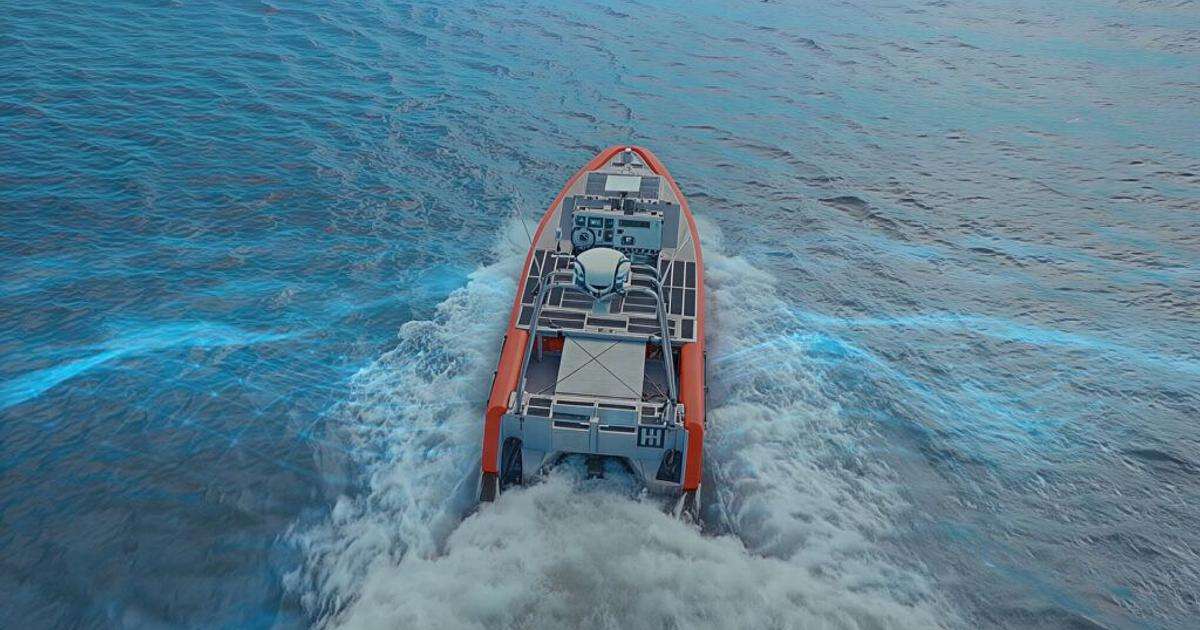
Nearby, previously deployed REMUS unmanned underwater vehicles (UUVs) are conducting mine countermeasure searches. When one vehicle detects a suspicious object, another autonomously diverts to classify it, while the ROMULUS USV relays confirmation and prepares to deploy a neutralization system.
Operators remain in the loop and retain authority over critical decisions, but unmanned platforms make thousands of decisions on their own—navigating, adapting, and collaborating to accomplish a mission that would be too complex for any single platform or operator alone.
For HII, that scenario illustrates how advanced autonomy paired with unmanned platforms could improve operational efficiency while reducing risks to forces and missions in increasingly contested environments.
While much of the defense industry’s recent focus has centered on unmanned platforms themselves, HII is making the case that the software for those systems to operate independently will prove to be the more consequential technology.
HII’s Odyssey Autonomous Control Solutions (ACS) software is designed to provide the decision-making architecture that allows unmanned maritime systems to perceive their surroundings, coordinate with manned and unmanned platforms, and complete missions with limited or no human intervention.
“Our approach to autonomy is intentionally different,” said Duane Fotheringham, President of HII’s Unmanned Systems business group. “Instead of a vertically integrated, closed ecosystem, we employ a modular open systems strategy that enables integration of best-of-breed technology partners and gives our customers choices.”
That approach comes as the US Navy and allied navies increasingly embrace distributed maritime operations, in which large numbers of manned and unmanned platforms share sensing, communications, and mission-execution responsibilities across vast operating areas. The war in Ukraine, persistent mine threats in strategic waterways, and growing competition in the Indo-Pacific have accelerated interest in autonomous maritime systems that operate where communications may be intermittent and GPS unavailable.
HII’s Odyssey ACS serves as a common, cross-domain autonomy layer capable of operating across multiple platforms within distributed fleets.
“If 71% of the Earth is covered in water, the ability to achieve effects is constrained more by the quantity of robots we can produce than their autonomy,” said Jeremy Shattuck, Chief Technology Officer for HII’s Unmanned Systems business group. “The autonomy required to operate these robots can be solved by Odyssey ACS. Developing high-end maritime autonomy synthesizes years of autonomy development, modular philosophy, operational experience, missions, production, and sustainment, which HII has.”
HII’s experience provides much of the foundation for that claim. The company has delivered more than 750 REMUS UUVs to more than 30 countries, with more than 90% of those systems still in service after 25 years. Odyssey ACS has also been integrated across more than 30 different unmanned surface platforms, providing engineers access to operational data collected from military, commercial, and scientific missions worldwide.
According to Shattuck, that experience creates an autonomy-development cycle that distinguishes Odyssey ACS from an industrywide overreliance on artificial intelligence (AI).
“Artificial intelligence isn’t autonomy,” he said. “AI is integrated throughout an autonomy stack, but autonomy is the software that allows a robotic vehicle to manage input from the platform layer up to the mission layer, understand its surroundings, make decisions, to accomplish an objective.”
Shattuck likens Odyssey ACS to replicating the crew of a ship’s bridge—maneuvering autonomy—and the functions performed across multiple departments needed for complex missions. Those functions range from flight operations, including cross-domain integration with other unmanned vehicles and autonomous launch-and-recovery mechanisms, to radio-room functions that maintain operations in communications-denied environments, and mission-specific payloads and platform behaviors.
That distinction becomes increasingly important in contested environments, where unmanned platforms must continue performing despite disruption or attack. Rather than waiting for remote instructions, Odyssey ACS senses its environment, adapts to changing conditions, and continues executing missions when satellite communications are lost, GPS signals are degraded, or the autonomous platform encounters hostile action. Unmanned underwater, aerial, and surface vehicles (UUVs, UAVs, and USVs) can detect and evade threats, alter routes around obstacles, manage energy reserves, select alternate communications paths, and coordinate with other unmanned systems without continuous human oversight.
HII affirms that collaborative autonomy is among Odyssey ACS’s most significant differentiators.
Many autonomous systems today focus primarily on controlling a single platform. Odyssey ACS is designed to coordinate various fleets operating across multiple domains. A USV can serve as a communications gateway for underwater vehicles, launch and recover other unmanned systems, redirect assets as mission priorities change, and continue coordinating operations even when individual vehicles lose connectivity.
Autonomous mine countermeasures provide one of the clearest examples.
Instead of requiring platforms and operators to perform each task sequentially, Odyssey ACS allows multiple systems to divide autonomous mine countermeasures responsibilities. One REMUS vehicle can search for contacts while another classifies potential mines using different sensors, as a ROMULUS surface vessel coordinates the broader operation and deploys neutralization capabilities. Operators can remain at a safe distance and stay “in the loop” for engagement decisions while allowing autonomous systems to handle the thousands of routine judgments required to complete the mission.
The Modular Open System Architecture (MOSA) approach also addresses a practical challenge facing navies as autonomous fleets expand: integrating new technology without repeatedly redesigning the underlying platforms.
As governments seek to avoid vendor lock while rapidly incorporating new sensors, communications systems, and software capabilities, Odyssey ACS evolves without requiring wholesale system reconfiguration. Its software-defined architecture supports over-the-air upgrades for UUVs and USVs, incorporating or replacing new payloads, AI models, encryption technologies, and mission applications as operational requirements change.
That adaptability is supported by a mature software-factory methodology in which engineers develop and validate new autonomy capabilities through software-, hardware-, and vehicle-in-the-loop testing before deploying Odyssey ACS aboard operational systems. HII’s digital simulation environment allows new behaviors to be evaluated across thousands of virtual missions before they are introduced into the fleet.
Fotheringham said that ability to adapt quickly will become increasingly valuable as navies gain more operational experience with autonomous systems.
“As we get more systems operational, our partners are going to learn a tremendous amount,” he said. “One of Odyssey ACS’s strengths is its open architecture and our ability to rapidly upgrade the software, add new capabilities and adapt as those lessons are learned.”
As maritime autonomy shifts from experimentation toward operational deployment, HII is committed to providing the decisive advantage of building the next unmanned vessel with software that enables fleets of autonomous systems to sense, decide, collaborate, and operate alongside sailors in increasingly contested seas.