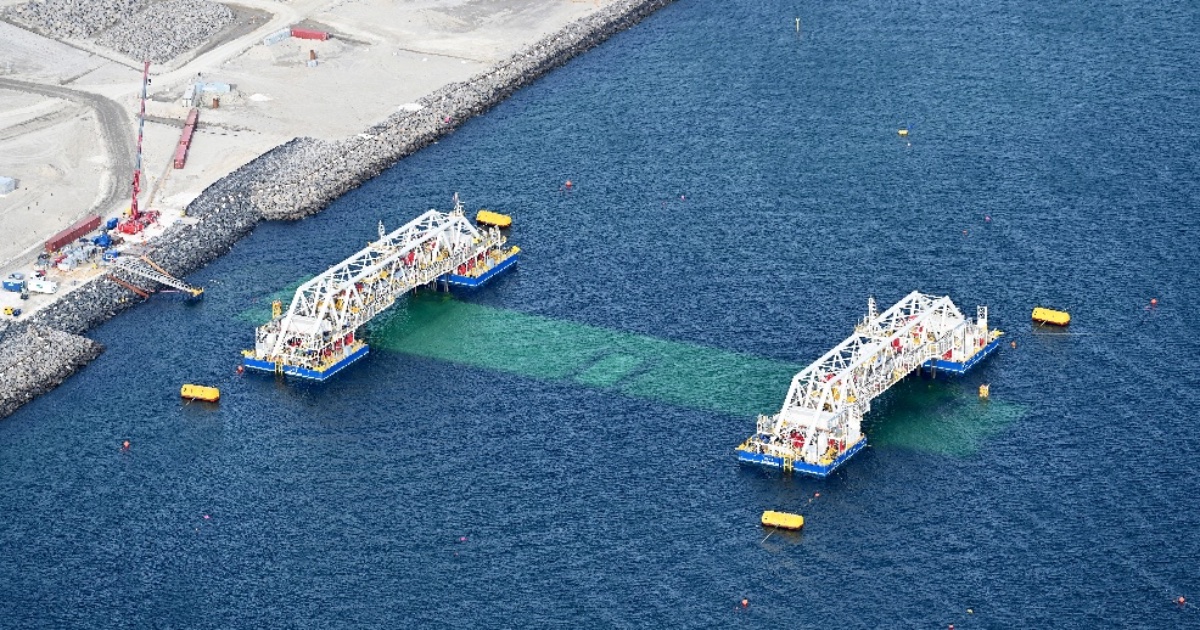
The tunnel spans approximately 18 kilometers and is laid at depths of up to 40 meters below the sea surface. Three of the 89 tunnel elements have now been successfully immersed and connected as construction of the Fehmarnbelt Fixed Link continues.
Standard elements measure 217 meters in length and 42 meters in width, and each immersion involves floating a 73,500-tonne tunnel element out of the work harbor, towing it offshore, lowering it into the shallow seabed trench, and guiding it into final position.
System Refinement Across the Process Phases
Based on an initial concept developed by FLC, MacArtney helped refine the system design through iterative engineering as installation methods and operational requirements evolved throughout the project. With design, testing, project management, and on-site support based in Denmark, frequent interaction, prototype validation, and ongoing optimization shaped the configuration ultimately used in the field.
Jes Højlund, Sales Manager at MacArtney HQ, commented: “The collaboration with FLC has been open and productive on both sides. We worked closely with the installation teams and adapted the solution as requirements became clearer. Because we were locally present, we could be on site when needed and support the project as it developed.”
Infrastructure Connecting Topside and Tunnel Elements
The resulting power and connectivity infrastructure spans tunnel elements and the modular Immersion Pontoons IVY 1 & IVY 2, supporting positioning, monitoring, and control during immersion.
Prior to immersion, Retrieval Frames are connected above water to pre-installed Bulkhead Connector Plates. Equipped with cameras, lighting, and actuators, they enable monitoring and controlled operation during the connection and release sequence. This configuration supplies power and data to pumps and sensors within the tunnel element. Once positioning is complete, the Retrieval Frames are disconnected and recovered by a remotely operated vehicle (ROV).
Supporting this is a broader infrastructure comprising umbilicals containing power, Ethernet, and coax cables, including integrated SubConn® connectivity that enables power and data transmission between topside systems and tunnel elements.
The system also incorporates control units for power distribution and data handling, MacArtney stress terminations, armadillos, mounting frames, NEXUS multiplexers, and junction boxes installed on tunnel elements and aboard the Immersion Pontoons.
Together, these technologies underpin the activities required to place each tunnel element on the seabed, reflecting a solution developed in cooperation with FLC.
“The project has been inspiring. We’ve had people from different parts of FLC and our organization involved, and it’s been great to see so many of our technologies applied in a single project. It is rewarding to see that element installation is progressing successfully and that the solution is performing as intended in the field,” concluded Jes.