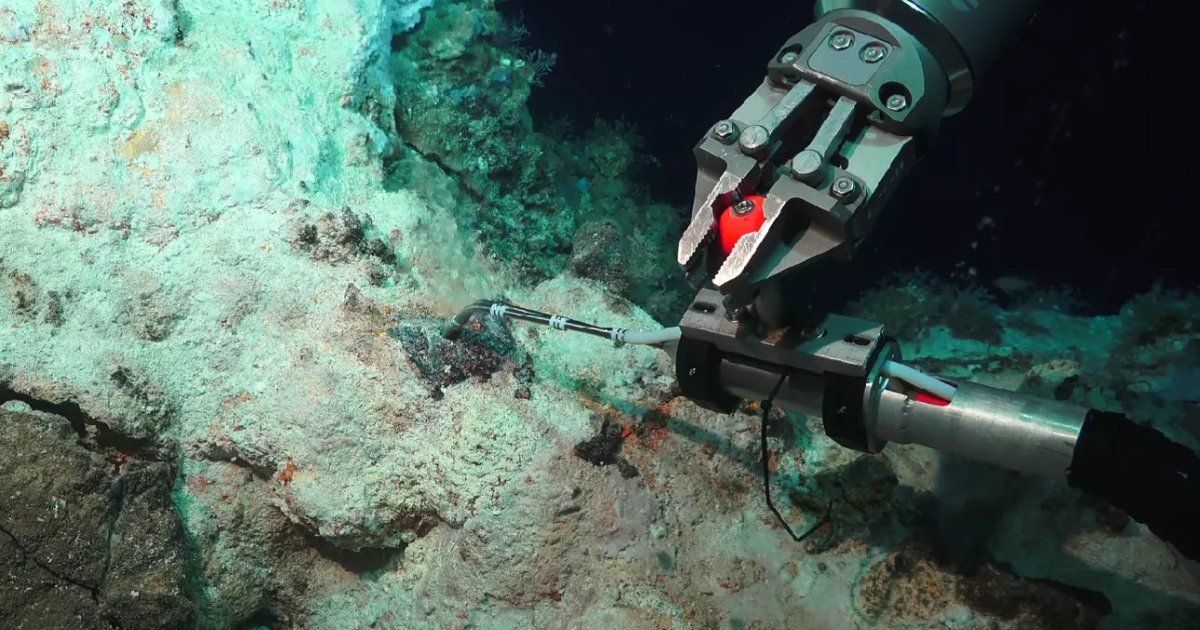
In August 2023, the German research vessel METEOR set sail on Expedition M192 to the Greek island of Milos with Dr. Solveig Bühring as the chief scientist. The mission was to locate and investigate so far unknown hydrothermal systems. Now, three years later, a new study highlights the surprising discoveries resulting from this expedition. At the newly discovered hydrothermal system in intermediate water depths of 100 to 250 meters, researchers were able to demonstrate how different intensities of hydrothermal fluid flow shape microbial communities and control mineral formation on the ocean floor.
Around Milos, two fundamentally different types of hydrothermal venting occur relatively close to each other: slowly diffusing fluids and vigorously venting (‘advective’) hot fluids. “These two hydrothermal regimes create completely different habitats for microorganisms,” said Dr. Joely Maak, the study’s lead author and researcher at MARUM. In areas dominated by diffuse fluid flow, seawater penetrates multiple centimeters into the sediments. As seawater infiltrates the sediment, it supplies dissolved sulfate, which is utilized by sulfate-reducing microorganisms. Their metabolism promotes the formation of pyrite within the sediment. In contrast, where hot, acidic fluids are discharged through vigorous venting, sulfate-rich seawater is absent. Instead, sulfur-oxidizing bacteria colonize the interface between reduced hydrothermal fluids and oxygenated seawater. At the interface, elemental sulfur precipitates.
Mineral Precipitation is Not Only Limited to Geological Processes
For a long time, mineral formation in active hydrothermal systems was considered a consequence of primarily abiotic geological processes. “The new study now demonstrates that microorganisms actively contribute to processes shaping the ocean floor. This study is the first to investigate the newly discovered hydrothermal systems in detail following their initial description at the end of 2025 in Scientific Reports and provides the foundation for future investigations of these unique environments,” explained Dr. Marcus Elvert, the study’s project leader.
Biological and Geological Processes at the Ocean Floor are Closely Linked
To identify the different microbial metabolisms, the research team combined a wide range of analytical approaches, including compound-specific isotope analyses of fatty acids to identify various metabolic pathways, mineralogical analyses, sulfur isotope measurements, and porewater geochemistry. Only by integrating these complementary methods was it possible to reveal how closely biological and geological processes are interconnected.
This work was made possible through the close collaboration of a highly interdisciplinary team. The team included Clemens Röttgen, Birte Winkelhues, Eirini Anagnostou, Solveig I. Bühring, Andrea Koschinsky, Jianlin Liao, Harald Strauss, Christoph Vogt, Wolfgang Bach, Enno Schefuß, and Marcus Elvert. Bringing together these diverse areas of expertise, including geomicrobiology, mineralogy, and geochemistry, made it possible to comprehensively unravel the interactions between hydrothermal fluid flow, microorganisms, and mineral formation.
The study is an integral part of research in the Cluster of Excellence “The Ocean Floor – Earth’s Uncharted Interface.” The cluster aims to better understand ocean floor ecosystems under changing environmental conditions, as well as central material cycles, such as the carbon cycle.
The findings are based on samples and data collected during Expedition M192 aboard the German research vessel METEOR III. Although METEOR III has now completed its final voyage after nearly four decades of scientific service, the samples and data collected during its expeditions continue to provide new insights into previously hidden processes occurring on the ocean floor.