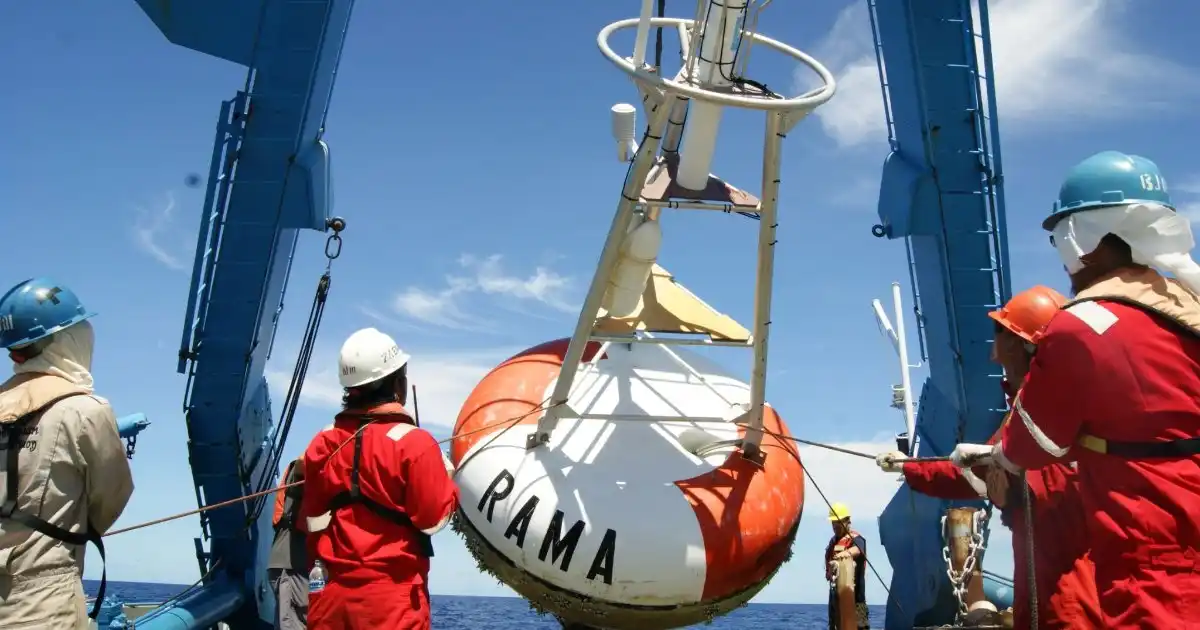
To sustain these important observations, NOAA Research and India’s National Institute of Ocean Technology (NIOT), under the Ministry of Earth Sciences (MoES), renewed their longstanding ocean observing partnership for another year on September 4, 2026. The agreement supports continued collaboration on two major observing networks: the Research Moored Array for African–Asian–Australian Monsoon Analysis and Prediction (RAMA) and the Ocean Moored Buoy Network (OMNI).
[IMAGE_2_PLACEHOLDER]
More than Two Decades of Ocean Observations
Since the RAMA network began in 2004, international partnerships have helped transform the Indian Ocean from a region with limited ocean observations into an important source of information for weather and climate research. Together, RAMA and OMNI collect measurements of ocean temperature, salinity, currents, winds, and other conditions that influence weather patterns.
Unlike ships that collect measurements while traveling, these buoys remain anchored at fixed locations, continuously monitoring the ocean and surface atmosphere as conditions change. Some sites now have nearly two decades of observations, giving researchers valuable long-term records to better understand ocean variability, monsoons, and the connections between the Indian and Pacific Oceans.
Maintaining these observations requires sustained international cooperation. India provides dedicated research vessel time, often involving approximately month-long expeditions, to deploy, recover, and service moorings in the Indian Ocean. NOAA’s Pacific Marine Environmental Laboratory (PMEL) contributes specialized mooring technology, engineering expertise, and data management capabilities. PMEL’s operations are supported by NOAA’s Global Ocean Monitoring and Observing (GOMO) Program.
A cornerstone of this partnership is its commitment to making ocean observations freely and openly available. Data are transmitted from the buoys in real time and shared through international systems that are used by weather forecasting centers worldwide. After the instruments are recovered, PMEL researchers conduct additional quality checks and make more detailed, higher-resolution observations available for research.
This approach allows the same observations to serve two important purposes: helping forecasters understand current ocean and atmospheric conditions while providing scientists with the long-term records needed to improve future predictions.
“The success of the RAMA array has depended on the commitment of ship time and scientific collaboration from NOAA’s international partners, including the Ministry of Earth Sciences (MoES). PMEL has played a pivotal role in maintaining RAMA moored buoys and collecting long time series of ocean-atmosphere data in the data-sparse Indian Ocean Basin,” said
Looking Ahead: New Technology and Evolving Science Priorities
As ocean observing technology advances, GOMO and its partners are exploring how to make these networks more effective and responsive to emerging research needs. Newer generations of observing systems offer more flexible instrumentation, improved communications, and expanded capabilities for transmitting data in real time.
At the same time, researchers are assessing whether existing observations continue to address the most pressing scientific questions. Priorities include improving monsoon prediction, understanding El Niño and its influence on the Indian Ocean, studying connections between the Indian and Pacific Oceans, and examining the Madden-Julian Oscillation and other emerging ocean signals. The collaboration also provides opportunities to strengthen access to observations from India’s OMNI network in the Bay of Bengal and Arabian Sea, supporting a broader understanding of conditions across the northern Indian Ocean.
As NOAA and India build on their decade-long partnership, the goal remains clear: to maintain the observations scientists rely on today while adapting the networks to meet tomorrow’s research and forecasting needs. From the Indian Ocean to the United States and beyond, these international efforts strengthen our understanding of interconnected ocean and weather systems, helping improve forecasts and preparedness for communities around the world.
This article was originally published here: https://globalocean.noaa.gov/connecting-oceans-improving-forecasts-noaa-and-india-renew-their-ocean-observing-partnership/