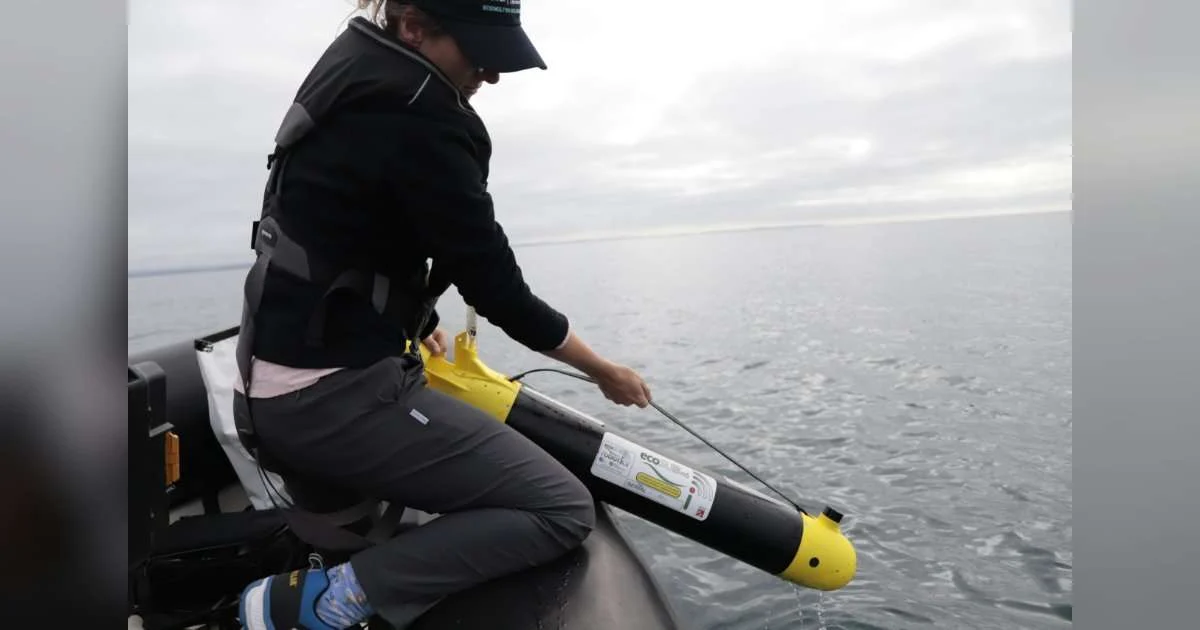
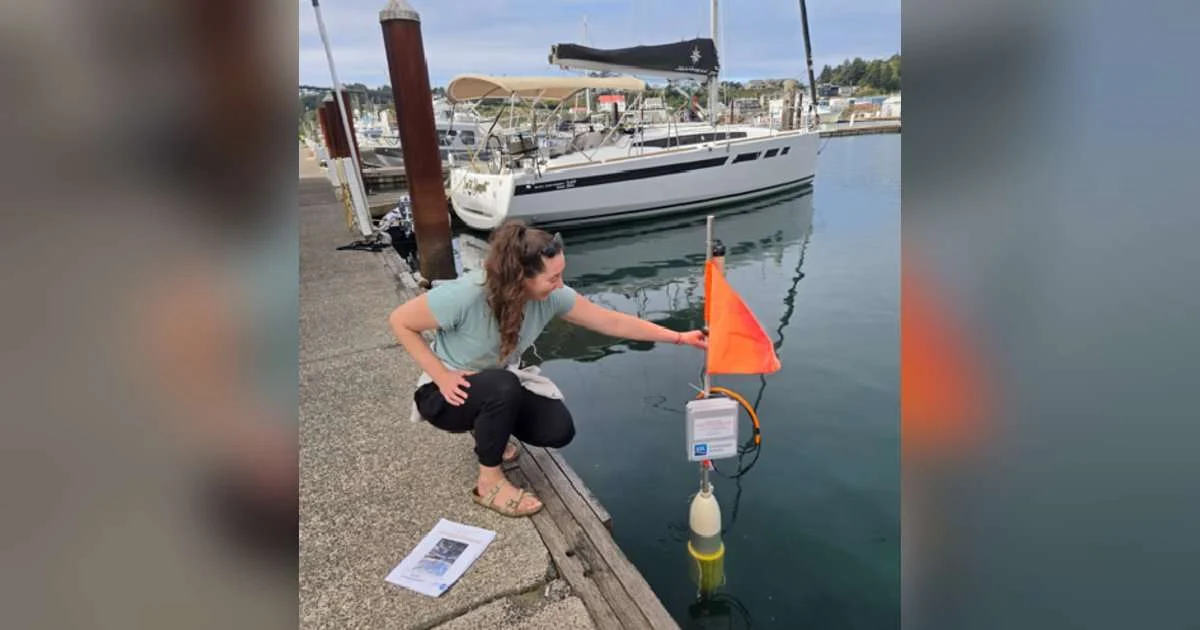
During the pilot effort, the team deployed and recovered the AZFP-nano surface drifter four times around foraging whales with the objective of investigating predator-prey dynamics. Fortuitously, gatherings of humpback, blue, and fin whales were encountered during the survey. The AZFP-nano surface drifter mapped water column zooplankton, the whales’ prey, around the foraging animals. A separate drifter equipped with a hydrophone was deployed at the same time to record whale calling behavior. Together, the acoustic prey measurements and whale behavior observations are intended to support fine-scale analysis of predator-prey relationships.
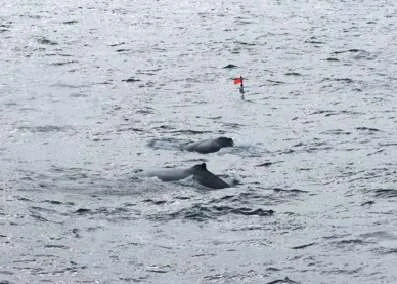
The Oregon State University team reported that the prototype was successfully deployed and recovered during the survey and that the new design worked well in the field. At the heart of the AZFP-nano surface drifter is a compact, lightweight, single-frequency 200 kHz scientific echosounder. The AZFP-nano is a miniaturized version of the AZFP, making it highly portable and well suited to challenging environments. It is powered by standard D-cell batteries, allowing for extended deployments without the need for specialized power systems.