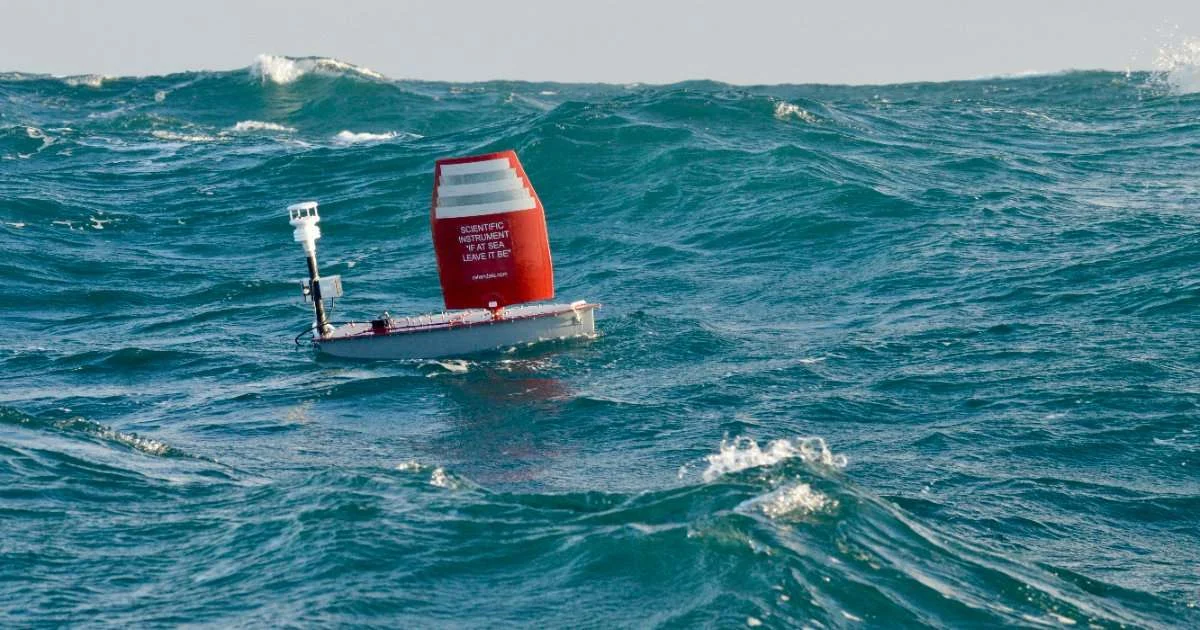
Created by two academics, Dr. Mark Neal of Aberystwyth University and Dr. Yves Briere of the Institut Supérieure de l’Aéronautique et de l’Espace (ISAE), Toulouse, the Challenge is billed as a ‘friendly competition’ to cross the Atlantic in the fastest time. Oshen provides persistent, wide-area maritime intelligence using C-Stars, small, autonomous vessels that act as eyes and ears across the world’s oceans.
The rules for fully autonomous boats are exacting. Entrants must make their way across the ocean entirely unassisted—once underway, teams cannot influence the vessel’s decision-making or change its course. Boats must also be small: no more than 2.4 m long. This deliberately limits the deck area available for solar panels and therefore the amount of power for onboard systems such as computers and thrusters.
The technical and physical barriers are such that the fully autonomous prize remained unclaimed for 16 years. More than 30 attempts have been made since 2010, by organizations including Shanghai University and France’s Ecole Navale. The US Naval Academy has tried six times. Oshen is the first to succeed, on its third attempt.
The first, in 2023, ended after just 20 days and 10 km. Two years later, a modified boat set off from Plymouth and sailed for 277 days, getting three-quarters of the way across the Atlantic, before losing its sail in heavy seas. Though frustrating, this experience, plus 1,000 more days at sea, helped Oshen develop its technology to the point where C-Stars are now routinely deployed on long-duration missions in extreme environments.
The boats are sensor platforms used in defense to help safeguard undersea data cables and pipelines, to monitor illegal fishing and dark fleet tankers, and by scientists to gather oceanographic, climate, and wildlife data. Operating singly or in fleets (‘constellations’), they record up to 2 million data points per day, measuring variables such as sea surface temperature, air temperature, air pressure and humidity, salinity, and water density. Oshen has created its own autonomous navigation software, and vessels continually assess wind speed and direction, currents, and battery life, in order to hold position or sail themselves to pre-selected destinations.
The robustness that helped them win the Microtransat was demonstrated in September 2025 when three C-Stars on a mission for NOAA, the US weather agency, intercepted Hurricane Humberto. C-Star PC8 sailed directly into the eyewall while Humberto was rated ‘Category 5’—the most powerful and destructive class of storm. It survived hours of punishment from 10 m (30’) waves and winds exceeding 240 km/h (150 mph), transmitting valuable live data later reported in official forecasts. C-Stars remain the only uncrewed surface vessel (USV) to have achieved this (1).
PC13 did not encounter a hurricane during its Atlantic crossing, but it did sail through the developing low-pressure system associated with Storm Dolly on August 28–29, around day 113 of the mission.
Anahita Laverack, CEO and Co-Founder of Oshen, said: “We are thrilled to have finally completed the Microtransat. Even in the final hours, after so many days at sea, we weren’t certain that PC13 would reach the designated finishing zone. It is a great result and a fantastic validation of all the effort the team has put into making C-Stars the world’s most capable sail-powered USV. It also means a great deal personally: it was learning about the Microtransat Challenge while at university that set us on the path to creating Oshen.”