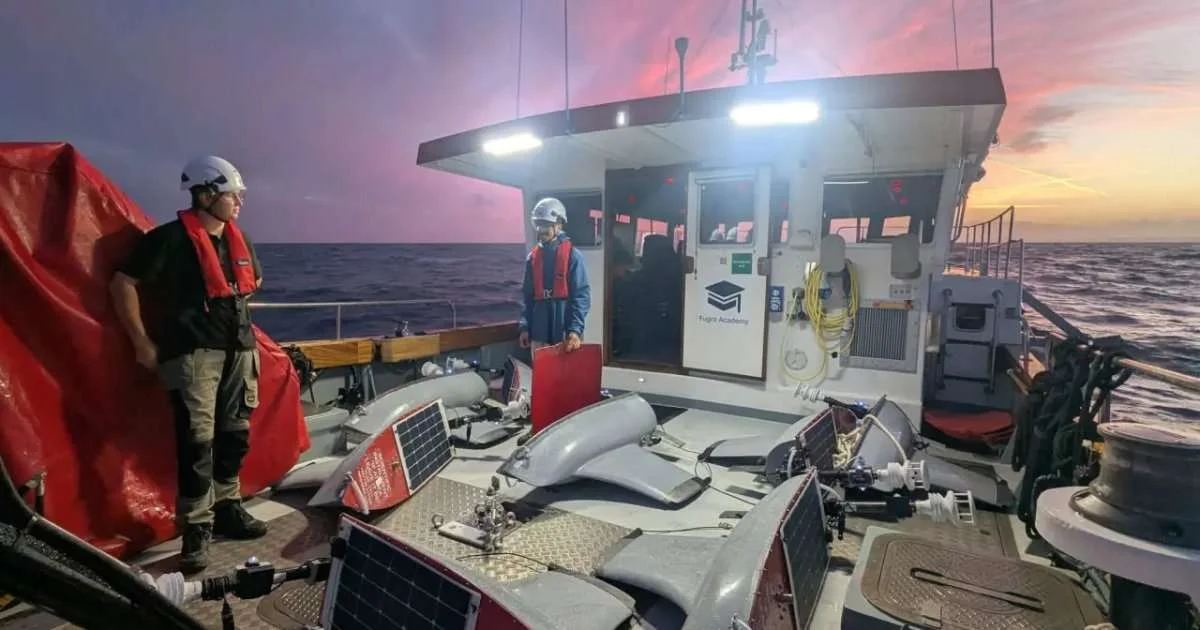
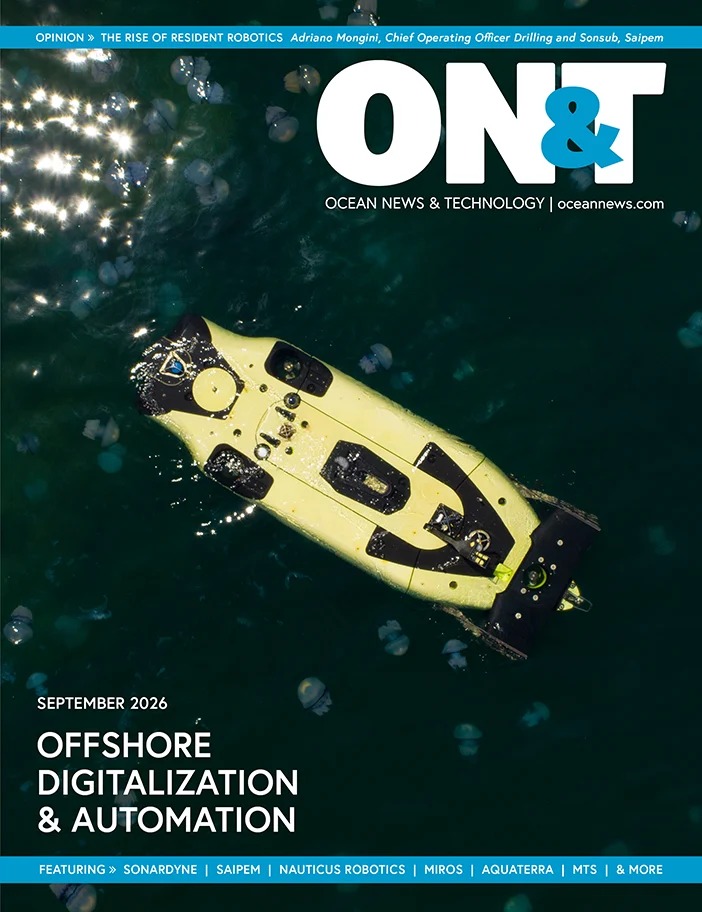
Lightfish are 12-ft, 350-lb solar-powered vehicles that have been in use with the US Navy and commercial customers around the world since early 2023. The transit launched from the company’s headquarters in San Diego, stopped in Hawaii for a demo, took pictures on its way past Wake Island and Guam, participated in another demo in Okinawa, and finished its journey on mainland Japan.
In total, the Lightfish traveled over 7,500 miles over 150 days, showcasing its exceptional reliability and endurance. Throughout the voyage, people followed along via a publicly accessible tracking page displaying a 24/7 ocean intelligence feed, including key boat health metrics, nearby vessel tracking via AIS and cameras, and live video of fish swimming alongside the ASV.
“In this industry, there’s a lot of talk. We went with a public tracking page because we wanted to break that trend by showing real data instead of just PowerPoints,” said Max Kramers, Seasats’ Co-Founder and Head of Vehicle Design.

Demand for low-cost, highly capable unmanned systems is increasing rapidly. Just two weeks ago, the Secretary of Defense announced a memo on unleashing US drone dominance and modernizing the DoD’s use of low-cost drones.
“Since we launched the Lightfish two and a half years ago, we’ve been quietly building a track record through real-world customer operations,” said Mike Flanigan, CEO and Co-Founder of Seasats. “This mission just isn’t possible with any other USV on the market right now. The ability to hand-launch a vessel from a beach and then control it in real time, 5,000+ miles away, with pinpoint accuracy and maneuverability, is game-changing for maritime operations.”
This capability has already resulted in many deployments around the world: earlier this year, Seasats celebrated the milestone of operating Lightfish on every inhabited continent. Customers include various US Navy groups as well as universities, research labs, and commercial customers.
Lightfish adoption has been driven by the ASV’s combination of capability and practicality. Its compact size enables rapid launches out of the back of a pickup truck, while its modular payload capability serves a variety of missions. Defense customers have used Lightfish for intelligence, surveillance, and reconnaissance (ISR), security, sub-sea communications, electronic warfare, and other missions, while commercial customers have used Lightfish to monitor wildlife, track harmful algal blooms, and create bathymetric maps of channels and harbors.
“We’re proud of this milestone,” said Dylan Rodriguez, Seasats’ CTO and Co-Founder. “But we want to make this type of mission a routine event. We’ve got excited customers, we’re scaling rapidly, and soon we’ll have vessels continuously navigating oceans around the world.”