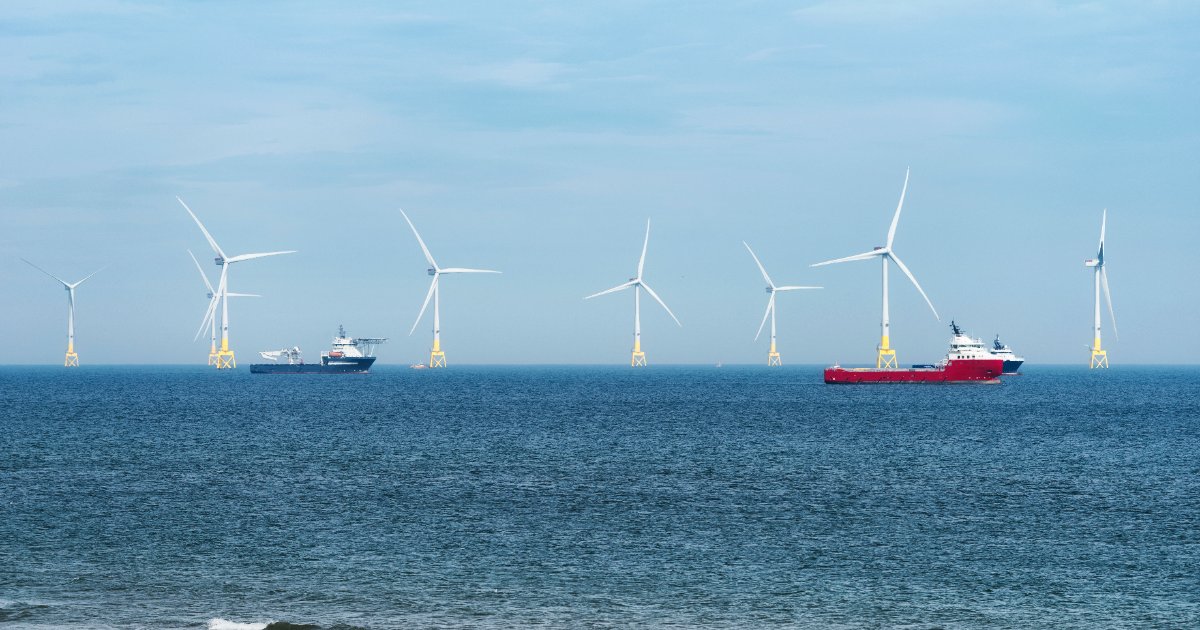
GlobalData’s latest report, “Europe Renewable Energy Policy Handbook 2026,” reveals that offshore wind is increasingly being treated as strategic infrastructure rather than simply another generation technology. The region’s policy direction mirrors broader market evidence that offshore wind has become one of the few scalable, utility-grade renewables capable of delivering very large annual increments of low-carbon electricity.
Attaurrahman Ojindaram Saibasan, Power Analyst at GlobalData, commented: “Governments are increasingly designing auctions to balance cost discipline with deliverability adapting contract structures, redefining risk allocation for grid links, and tightening pre-qualification rules so awarded projects are genuinely buildable. The key differentiator is no longer only who offers the lowest price, but who can deliver at scale under permitting limits, supply-chain constraints, and increasingly complex grid integration.”
A defining trend is how European auction designs are being re-engineered, moving toward two-way Contracts for Difference (CfDs) or equivalent stabilization tools that reduce revenue volatility while retaining price discipline. At the same time, policy is expanding beyond “price-only” outcomes, introducing clearer rules on indexation, delivery timelines, non-performance penalties, and increasingly, industrial and sustainability criteria.
Recent examples illustrate how these trends are playing out on the ground. In Germany, a 2025 auction for two centrally prepared North Sea sites totaling 2.5 GW received no bids. Observers attribute the failure in part to the absence of revenue stabilization tools like two-way CfDs, unresolved permitting risk, and misalignment between project schedules and grid readiness.
France in mid-2026 launched a combined tender of about 10 GW, equally divided between fixed-bottom and floating offshore wind across its maritime façades. This signals both acceleration and strategic commitment to floating technology. The UK’s latest CfD round awarded over 8 GW of fixed-bottom offshore wind plus floating projects, with strike prices for fixed-bottom projects notably lower.
Europe is also diversifying offshore wind itself. Fixed-bottom remains the workhorse where shallow waters allow, but floating offshore wind is moving from pilots into the early commercial arena. Several European governments are now explicitly preparing floating tenders, adjusting subsidy models to reflect higher costs and technology risk while seeking to unlock deep-water resources.
Saibasan continued: “This shift is strategically significant: it expands the viable geography for offshore wind in parts of the Atlantic and Mediterranean, and it supports new industrial ecosystems around floating foundations, mooring systems, dynamic cables, specialized ports, and new O&M models. For investors, floating wind signals both higher near-term risk and potentially larger long-term addressable markets, especially as learning curves and industrialization reduce costs over time.”
A parallel development is that offshore wind is increasingly integrated into broader “energy system” planning, not only power generation planning. Policy and market frameworks are beginning to treat offshore wind as a platform for electrifying industry, enabling clean hydrogen and e-fuels, and reinforcing cross-border interconnection and balancing.
Saibasan concluded: “Offshore wind is now one of Europe’s most consequential renewables battlegrounds not only for decarbonization, but for energy security, industrial competitiveness, and long-term power affordability. The next winners will be those jurisdictions that combine credible auction design with fast, transparent permitting and investable grid delivery.”